Flicka Friends · Volume 16, Issue 1

Winter 2014

28 pages · edited by Tom Davison · contributions from Tom Davison, Bob Collier

Download the original PDF — scanned exactly as published

In this issue

  1. Flicka Stands and Cradles
  2. Cribbing and Boat Stands — Tom Davison (p4)
  3. HEART of GOLD’s Cradle — Tom Davison (p6)
  4. A Jowi Cradle for ZANZIBAR — Tom Davison (p14)
  5. Lifting A Flicka — Tom Davison (p18)
  6. Hauling A Flicka — Tom Davison (p22)
  7. Flicka Factory Cradle — Tom Davison (p24)
  8. Supporting RED RASCAL — Bob Collier (p25)
  9. Shopping For A Cradle (p26)

Cribbing and Boat Stands

By Tom Davison · page 4 · Winter 2014

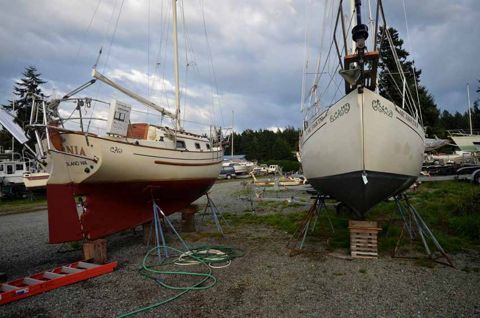
Two Flickas on boat stands: SARNIA and BLUE SKIES. Photo: Tom Davison © 2014

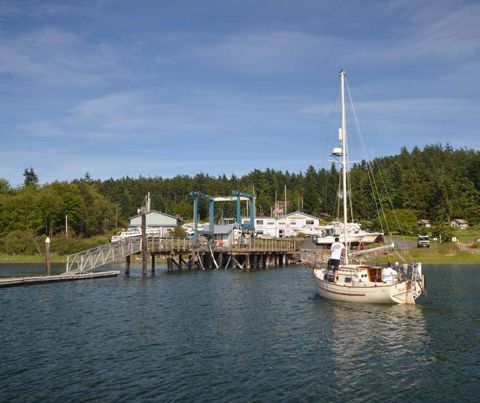
After the trip to the San Juan Islands in Washington State in October 2012 to buy my Flicka, I needed a place for storage. The previous owner used one of the two marinas in the bay and I decided to use them as well. Since they were the only one with a travel lift, there really was no decision to make and no other option either on the bay.

They used a Travel-lift to raise my Flicka from the water, and then drive it across the road, and up a slight hill into the marina yard. Along the way out of the water, they stop to pressure wash the hull. The whole process takes roughly an hour from beginning to end for hauling out including power washing. Since launching skips cleaning the hull, it takes roughly thirty minutes to get my Flicka into the water.

stands. The travel-lift straps are loosened and removed and the lift drives away leaving my Flicka high and dry until I get back again. As this particular issue of Flicka Friends developed, I began to research the use of boat stands and their history.

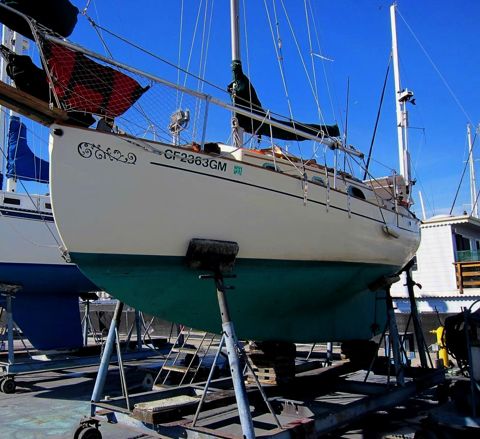
The marina where BLUE SKIES is stored in uses Brownell Boat Stands. The stands work perfectly and have for two winters so far. The marina provides the stands as part of my Getting my sailboat to the travel-lift basin was In the yard, my Flicka is driven into the area storage charge. a challenge in itself with the thirty-knot+ gale where it will be stored and lowered close to the winds astern. This wasn’t easy with no one on ground. Wooden cribbing or several logs are Brownell - The Brownell boat stand is the the dock to assist me. The rush was a falling positioned under the keel of the sailboat while make used to support my Flicka. Invented in tide, which required my arrival before the is lowered. 1954, these tubular stands are stronger than marina opened up for the day. angle section stands and are dipped in paint or Next, four boat stands are positioned fore and galvanized to prevent rust. The first time my Flicka was hauled, I watched aft to support the hull and keep it centered the entire process from beginning to end. The over the keel. Chains were used to connect Safety Chain - Part of the boat stand system marina would be hauling and storing my each stand with the one on the opposite side of was slots that secure a chain, which prevents Flicka and they did a great job. I was pleased. the boat. One stand is snugged up and the the stands from moving. This chain connects After three trips, they have lifted my Flicka for other is close until the chain is connected. A to another boat stand on the opposite side of me five times. The first two times, I watched final pull against the chain and the pad is the sailboat. Brownell recommends 3/8-inch adjusted. This process is repeated for the bow chain for their stands. every minute. 4

Cradle Bracket - While on Brownell’s website, I found another option for securing the boat stands. They sell cradle brackets that are clamped to the boat stand. The bracket also clamps around one inch outside diameter pipe, which can be used to create a solid connection between the boat stands. These brackets allow connecting the boat stands fore and aft as well as port to starboard. The chains only connect port to starboard. These brackets create something like a cradle for your Flicka. Setting the stands - Something that you should request is setting the hull correctly to allow proper draining. While I doubt that your Flicka would be set at an extreme angle, it would be best to have the hull set to allow the cockpit drains to work as intended. Cost - The boat stands used to support my Flicka are Brownell and retail as West Marine for $160 USD. If I were to purchase them, the cost would be $640. This is enough that the purchase of a cradle would be considered instead.

Two cribs and four boat stands support s/y BLUE SKIES. Photo: Tom Davison © 2014

Web Research - Digging around the web, other companies sell the stands for $30 less. Shipping would be the final factor for purchase. Paying truck freight costs for stands that weighs fifty pounds each could easily add $30. Picking the stand up at a local West Marine store if they ship for free might be the best option. If you live near another marine store and can get free shipping, that might be the least expensive of all. One thing that I didn’t like about the Brownell boat stand is the flat plywood pad. In Rik Sandberg’s article “Building a Cradle For Your Flicka,” he shows a boat pad that allows the plywood to bend with the surface of the hull. The Brownell models appear to be plywood that is completely supported by metal. This does not allow the pad to conform to the hull shape. Safety - Lifting a sailboat is serious business and you need to work with and for the lift operator during this process. If you are not sure of what will happen, ask a few questions before the process begins. The operator should be able to give you a quick explanation of what will occur.

Getting s/y BLUE SKIES ready for launching. Note the covers on the straps. Photo: Tom Davison © 2014

If you are aboard while launching, you need to listen to the instructions of the operator carefully. It is likely that you will be asked to check the bilge for leaks once you are in the water. Once you determine the bilge is OK, the slings will be loosened enough to free the hull. Make certain you follow the directions of the lift operator until you are clear of the slings and the lifting area. From that point forward, you are the captain again. 5 F

HEART of GOLD’s Cradle

By Tom Davison · page 6 · Winter 2014

Resting aboard a new boat cradle, s/y HEART of GOLD is ready for refitting. Photo: Riddy Lawless © 2013

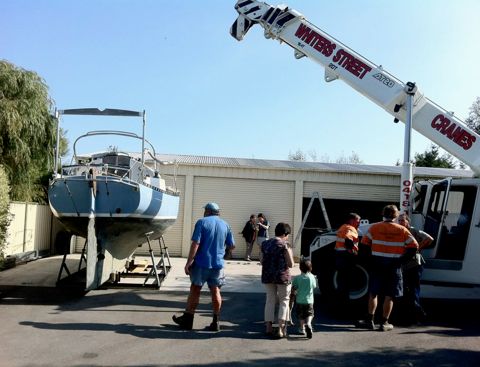
While researching cradles for the Flicka, I discovered a Flicka cradle built in Australia by Richard Lawless’s father. It was simple and appeared to fit the Flicka very well. Richard is currently refitting his Flicka, s/y HEART of GOLD, after sailing across the Tasman Sea from New Zealand to Australia. The stable platform created by the cradle should make working on his Flicka easier. I contacted Richard Lawless about his cradle. He replied, saying that he used the design from Rik Sandberg’s article “Building a cradle for your Flicka” which appeared in the Fall 2003 issue of Flicka Friends. While the design is somewhat different, the measurements were taken from the article. 6

The cradle was built without direct access to the Flicka. Richard e-mailed that the Flicka fit into the cradle perfectly. His cradle has six supports, three on each side of the sailboat. Having six supports means you can apply bottom paint by moving one of the pads at a time. This isn’t possible with just four pads. The keel was supported for much of the length with a board protecting the keel from the steel. This keel support was also angled to match the changes in the Flicka’s keel shape, which drops gradually to the transom.

without welding if something is damaged. A new idea or product could be added as well. The modifications on the “HEART of GOLD Cradle” make the cradle completely adjustable, something that welding the support arms in place would not allow. One change might be slots for the lifting straps. This would allow putting these straps in the locations that Pacific Seacraft specified. See the factory Lift Plan in “Lifting A Flicka” in this issue for more information. They are basically under the fore and aft cabin walls. This would complicate the cradle’s design, but would be worth the time, expense, and trouble.

One of the things that I liked about this cradle was the ability to lower the support arms to ground level. This would allow storing the I was pleased to see that an article published cradle in less space. This also meant that ten years ago was useful and the information replacement of the arms could be done proved to work perfectly.

After setting the slings, HEART of GOLD is lifted from the harbor. Photo: Richard Lawless © 2014

Getting close to the boat trailer for the trip to a new cradle. Photo: Richard Lawless © 2014

Nearly ready for the support arms and a road trip. Photo: Richard Lawless © 2014

Positioning the mast aboard for the road passage to storage. Photo: Richard Lawless © 2014

Backing my Flicka toward a new cradle in the storage area. Photo: Richard Lawless © 2014

Another crane was used to lift s/y HEART of GOLD from the trailer. Photo: Richard Lawless © 2014

The crane maneuvered s/y HEART of GOLD toward the new cradle. A 180 degree turn was required. Photo: Richard Lawless © 2014

Getting close to the new cradle for the first time, just another few inches. Photo: Richard Lawless © 2014

With six supports, s/y HEART of GOLD rests perfectly on the new cradle. Photo: Richard Lawless © 2014

Another view of the new cradle. The Flicka is ready for a refit. Photo: Richard Lawless © 2014

Measuring the length of the cradle. Photo: Richard Lawless © 2014

The final result is something of beauty. Photo: Richard Lawless © 2014

Measuring the forward support. Photo: Richard Lawless © 2014

Photo: Richard Lawless © 2014 Flicka Friends

Measuring the aft support arm. Photo: Richard Lawless © 2014

Center keel support and guide Photo: Richard Lawless © 2014

A Jowi Cradle for ZANZIBAR

By Tom Davison · page 14 · Winter 2014

Resting on a modified Jowi boat cradle and a yard trailer, s/y ZANZIBAR is stored for the winter. Photo: Tom Davison © 2014

When Randy Richardson purchased his Flicka, he needed to get the sailboat back from Maine. A local boat service was hired to make the trip to Maine and bring s/y ZANZIBAR to the Great Lakes. In order to support the Flicka on the trailer, a cradle was needed and a Dana owner offered his cradle for the trip. In order to make the cradle work, the keel support had to be built up with wood to raise the Flicka high enough to allow the pads to be used. 2011 - The Dana owner sold the cradle to Randy for storing s/y ZANZIBAR in a boat yard five miles from the marina. While this cradle supported the Flicka, it would need to be modified to fit the smaller hull. 2012 - In the fall of 2012, Randy moved his Flicka to a boat yard much closer to the marina. During the summer, they modified the Jowi 14

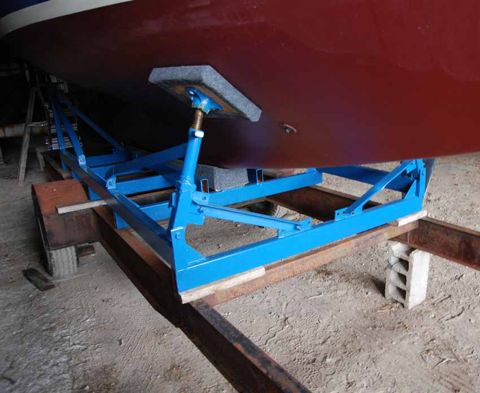
cradle to fit the Flicka. This was an important alteration, which turned the cradle from one that work well enough to a cradle that fit the hull of the Flicka. 2013 - The modified cradle was painted blue to match the hull of s/y ZANZIBAR. The wood keel support and the hull pads were all covered with new carpet. Looking around the yard, Randy’s Flicka cradle is one of the better looking cradles around the yard. The Jowi is offered in painted steel or aluminum. You can order one of the cradles through the Navstore. Their web page is: http://www.navstore.com/anchor-dock-cradle/boat-cradles/ The cradle in these photos should be a Jowi 1 with a limit of 10,000 pounds. They offer a smaller cradle (Jowi .5) with a limit of 5,000 pounds, which is less than the displacement of an empty Flicka. The Jowi 1 is strong enough for the Flicka. Flicka Friends F

The Jowi cradle was built for a Dana 24 and had to be built up for the Flicka. Photo: Tom Davison © 2014

The first winter on the Dana 24 cradle worked, but improvements were going to be made to the cradle. Photo: Tom Davison © 2014

The boat storage yard modified the Jowi to fit s/y ZANZIBAR. Photo: Tom Davison © 2014

The arms were shortened and modified to fit the hull of a Flicka. Photo: Tom Davison © 2014

The wood keel support angles to accommodate the shape of the Flicka keel. Photo: Tom Davison © 2014

With fresh paint and new carpet, the Jowi cradle is perfect for s/y ZANZIBAR. Photo: Tom Davison © 2014

ZANZIBAR waits comfortably for the marina to open in May 2014. Photo: Tom Davison © 2014

Lifting A Flicka

By Tom Davison · page 18 · Winter 2014

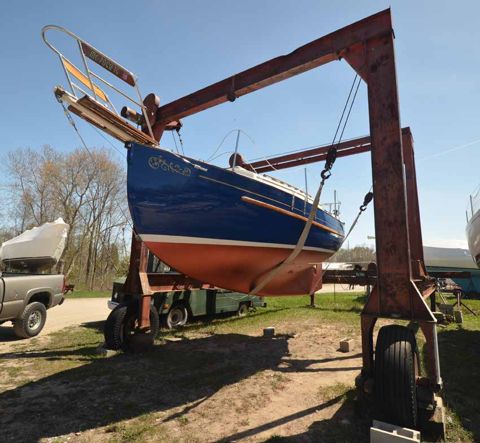
Waiting for her modified Jowi boat cradle, s/y ZANZIBAR hangs from a travel-lift. Note the brand new bottom paint! Photo: Tom Davison © 2014

If the boat yard is unfamiliar with the Flicka, you need to let the lift operator know about where to place the slings. The placement of the straps is important. An image of Pacific Seacraft’s factory lift plan shows that the lifting points are roughly in-line with the fore and aft limits of the coach roof. Plastic Strap Covers - The marina or boatyard should protect your sailboat from the straps. A plastic covering is often used to keep the bottom paint and topsides safe. I would expect this to be available. 18

Ropes - Because the forward strap isn’t placed under a flat part of the hull, it is very important that a rope is used to keep the two straps where they are placed after the lifting begins. Safety - The best thing you can do when the boat yard is moving your sailboat is to stay out of the way. Before moving your Flicka, you should ask a question or two. They will explain what they are doing. If something is needed, they will ask for it. The lift is usually a fast operation. Nothing fancy, just pick up the Flicka, move the trailer under the hull, lower, then position, and tie down. A-B-C and you are on the road. Flicka Friends F

The Flicka Manual shows the correct placement of the lifting straps. Do NOT locate the after strap under the rudder! Drawing: Pacific Seacraft © 2014

Fresh bottom paint this season for s/y ZANZIBAR. Photo: Tom Davison © 2014

The modified Jowi cradle headed toward s/y ZANZIBAR. Photo: Tom Davison © 2014

ZANZIBAR is carefully centered on the Jowi cradle. Photo: Tom Davison © 2014

Note the rope between the two lifting straps. Photo: Tom Davison © 2014

After centering , the four support pads were adjusted to the hull. Photo: Tom Davison © 2014

With pads adjusted to the hull, the lifting straps can be removed. Photo: Tom Davison © 2014

Hauling A Flicka

By Tom Davison · page 22 · Winter 2014

The marina crew is moving s/y SARNIA to the Travel-lift dock. A four foot tide is required at this dock for hauling a Flicka. Photo: Tom Davison © 2014

While there is a reservation for a launch time, this is always variable. The marina usually gives me thirty minutes notice before the While many of the previous articles in Flicka Travel-lift shows up. The process is real Friends have been about launching and simple. They position the Travel-lift around recovering a Flicka with a trailer, this issue my Flicka, the slings are carefully positioned includes information about using a travel-lift under the keel, they lift my sailboat, and drive to get a Flicka to and from land. Without it to the launch dock. owning a trailer and a boat ramp, the only way to get your Flicka from the water is to use a Once at the dock, I step aboard my Flicka and travel-lift. There are a number of things to they lower me and my sailboat into the water. They leave the slings tight while the bilge is consider for hauling your Flicka. checked for leaks or other problems. Once The depth of the water should be the first everything has been checked, the engine is concern. For saltwater sailors, the tide charts started. The slings are loosened enough for the need to be consulted before making any plan. Flicka to be powered out of the dock. s/y BLUE SKIES

In my case, the tide must be four feet for the marina to consider launching my Flicka. The tide level is actually checked before I book a flight across the country to go sailing. 22

running the show and you need to listen to the instructions given. There may be very little verbal communication during the lift, but you are expected to follow the directions. It is a good idea to have the wrenches for the packing gland out and ready. In the event they need adjustment, this task can be taken care of quickly. Depending on wind conditions, they may move your Flicka with lines rather than the engine. Controlling a Flicka along the dock in strong crosswinds is much easier with long lines than trying to use the motor.

Since the first two lifts (a haul-out and a launch), I’ve left the marina and had them take care of the recovery. They do a good job This is all real obvious stuff, but having only and my Flicka is well protected. The lift launched using trailers in the past, it was new operator commented once that they didn’t to me. There are a few things to know to make want problems any more than I did. That was the process fast and safe. The lift operator is reassuring. Flicka Friends F

While any boat owner is nervous about having the sailboat up in the air, they made this process look simple and routine. Photo: Tom Davison © 2014

After lifting, it is time to pressure wash the hull. Photo: Tom Davison © 2014

Flicka Factory Cradle

By Tom Davison · page 24 · Winter 2014

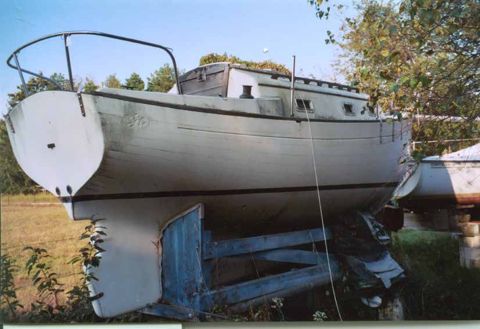
When I found the Flicka, it was still sitting on the original factory shipping cradle. Photo: Bill Lustusky © 2014

minimal and a flatbed trailer could be used to move your sailboat to higher ground.

Flickas were shipped from the Pacific Seacraft factory in California using a wood cradle. The photo above shows one of these cradles in use.

While a travel lift would be the easiest way to load the Flicka, with a hurricane just over the horizon, you might be able to haul out if the cradle was secured to the trailer.

There is a Flicka Friends article about the materials required to build one of the Pacific Seacraft cradles in the Summer 2006 issue of Flicka Friends. At that time, the cost of the wood and various nuts and bolts totaled $150$200. This is the least expensive option for storing your Flicka on land. The most difficult part of building the cradle would be scribing the bow and keel shapes for the hull supports. This could be accomplished using techniques designed for installing interior walls in sailboats. One other reason for investing the time and money for a boat cradle is for the Flicka owners that live in hurricane country. Getting your Flicka out of the water is the best way to protect your favorite little yacht. The cost is 24

This simple cradle could be built for routine maintenance while sailing in other countries if boat stands were not available. Your factory or home-built cradle will need some maintenance over the years if you use it long term. I’m sure that a coast of paint and new carpeting would be required. After a few years, using the wood cradle for transport may be suspect.

the boat yard, taking your Flicka down the road is another matter. Besides meeting legal requirements, the trailer must be adequate. While driving home five years ago, I passed a house where a Cape Dory 28 had been stored in their yard. It was not there and I wondered where they would be sailing. Over the next hill, I found out where. It looked like the trailer and tow vehicle were not suited for the job. While the trailer was rated for the weight of the sailboat, the overall length was short. The vehicle used to tow was also a short wheel base four-wheel drive.

From the marks in the road, it appeared that the trailer began to sway and while doing so, You would need to inspect the wood cradle one of the cradle supports broke. The Cape annually. Right after you launch for the season Dory ended up lying in the middle of the road. would be a good time. That would allow Getting the sailboat out of the road involved a making repairs during the summer. Waiting very large crane, a large semi flatbed truck and until the haul-out could cost you, both in more than two hours from start to finish. terms of frustration and boat yard costs. Hopefully, his insurance covered much of the The choice of flatbed trailers is an important accident and that they didn’t cancel his policy decision as well. While you might not need right after payment. Use an older wood cradle anything fancy to move your sailboat across for road transport with considerable caution. Flicka Friends F

Supporting RED RASCAL

By Bob Collier · page 25 · Winter 2014

RED RASCAL is supported by the garage floor and a cradle. Photo: Bob Collier © 2014

The aft support for s/y RED RASCAL. Photo: Bob Collier © 2014

The forward support for s/y RED RASCAL. Photo: Bob Collier © 2014

Shopping For A Cradle

Flicka Friends · page 26 · Winter 2014

While getting ready for a trip down to La Paz from California, NOMAD was placed on a boatyard cradle. Photo: Bill Hogan © 2014

Jowi - The Jowi is offered in painted steel or aluminum. This is the cradle that supports s/y ZANZIBAR.

There are a number of places to find boat cradles. A number of companies built them in a variety of styles. Any internet search will likely come up with a few that can build a cradle for you. You can also look around the closest marina or even contact a local sailboat broker for contact information for local builders.

Triad - They offer boat cradles as well as trailers for the Flicka. With Triad’s long history of building trailers for the Flicka, they would be an obvious first choice for a sailboat cradle.

Randy Richardson’s Flicka is supported by a Jowi cradle, one that he acquired used. Originally design for a Dana, it was modified to fit the Flicka over the summer. 26

I’m sure there are other cradle options out there and many different points of view about what might make a good cradle. Some might offer box metal tubes for the cradle and others recommend c-channel steel frames. Make sure that the rating for the cradle includes the displacement weight plus all the gear aboard. Flicka Friends F

How many days left until the boating season in Michigan? Photo: Tom Davison © 2014

Here are a few of the companies that I found on the internet. Cradle Ride Trailers

http://www.cradleridetrailers.com/Products.page?CategoryID=5149

http://www.navstore.com/anchor-dock-cradle/boat-cradles/

http://www.vikingtrailer.com/sailboats/cradles.html

Also in this issue

These pieces are in the archive but not yet transcribed — they're in the PDF.

  • Flicka Stands and Cradles

Every surviving issue is in the Flicka Friends archive. For the boats named here, see the Flicka 20 registry, or the Flicka 20 specs.