Flicka Friends · Summer 2001 · Vol 6, #2
Inboard or Outboard?
By Tom Davison · page 2 of the Summer 2001 issue
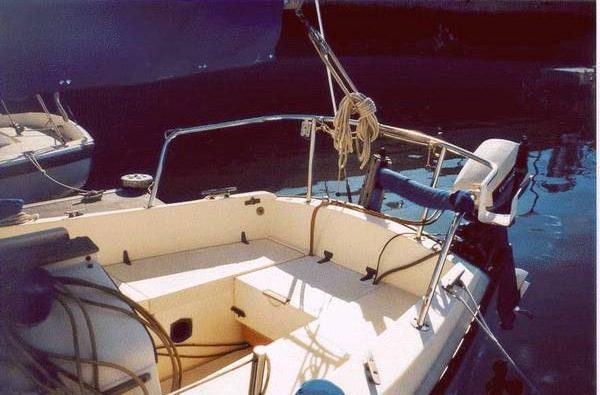
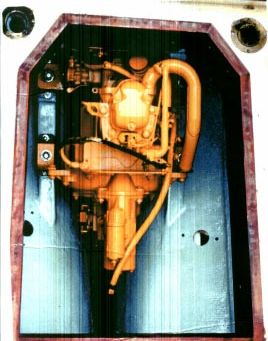
One of the fundamental decisions when buying a Flicka is engine choice. A number of comments from various sources have been gathered here. One Flicka owner had a Nissan five horsepower outboard. The five horse was a temporary replacement for a larger nine horsepower outboard. The captain said that the five horsepower outboard was really too small and would barely make it out of the marina if there was any sea running. From another Flicka owner, I've heard that the high thrust outboards models are the way to go. They provide the same thrust at one-quarter the throttle. He feels the outboard to be superior over an inboard for maintenance reasons. It is certainly cheaper to take your outboard engine into a dealer than to have a "diesel" mechanic make a trip to your boat. The outboard can be removed from the water, eliminating the drag from the lower unit and the prop. With an inboard reducing drag means a folding prop, i.e. expensive $1,000+. Offshore, the reduced drag might mean a few more miles per day. The outboard can be a source of power for your dinghy. With a large enough inflatable, you can move the outboard from Flicka to dinghy depending on your needs. One new aspect of outboard ownership are the beginnings of two-stroke limits. Lake Tahoe has limitations and there have been a number of articles about this. Buying a four-stroke outboard or one of the newer fuel injected two-strokes with a separate oiling system may be the prudent purchase. Theft may be something to consider. Removing an outboard from the transom doesn't take very long, removing a diesel isn’t very likely. The inboard offers a number of advantages. First of all, the prop is much lower in the water. The prop is also protected by the hull and the rudder. It is more “yacht” like to have the inboard. The outboard isn't there to clutter up the fine transom of the Flicka. Also, you don't have to hang over the transom to operate the outboard. While you can get remote controls for some outboards, installation would only get in the way of using the outboard on the dinghy. You might be able to say that the inboard diesel makes more sense if you are going to cruise coastal waters and the outboard is better offshore, at least in a pure sense. The outboard would eliminate a number of thru-hulls and the additional hazards relating to more holes in your boat. The diesel would reduce installation problems if you wanted to add a windvane to your Flicka at some point, but the Monitor windvane does fit well on a Flicka with a outboard.
There is also the diesel vs. gasoline argument. In my mind, diesel is much safer. The fuel consumption of a Yanmar is around one quart per hour. The older Flickas had a twelve gallon diesel tank and more recent models have an eight gallon tank. The twelve gallon tank gives a range of approximately 240 miles assuming that you are traveling at five miles an hour (12 gallons x 4 x 5 knots = 240.) It is also nice to reach down to turn a key to start the diesel rather than hang over the stern and pull a cord. You can of course purchase outboards with electric starters. With eight gallons, the range decreases to 160 miles (8 gallons x 4 x 5 knots = 160). There may be one other advantage to diesel power. The small Espar heaters run on diesel. If you live in a northern latitude this heater might make the early spring and late fall trips more enjoyable. The final decision may be just simple economics. An outboard powered Flicka is cheaper than one with an inboard diesel engine.
Advertisement
Transcribed from Flicka Friends, Summer 2001 (page 2). Read it as originally printed in the PDF, or see everything else in this issue.
Advertisement
Next in this issue
Newsletter or "E-Zine" Tom DavisonMore from the archive
Every surviving issue is in the Flicka Friends archive. Looking for a particular boat? Try the Flicka 20 registry.