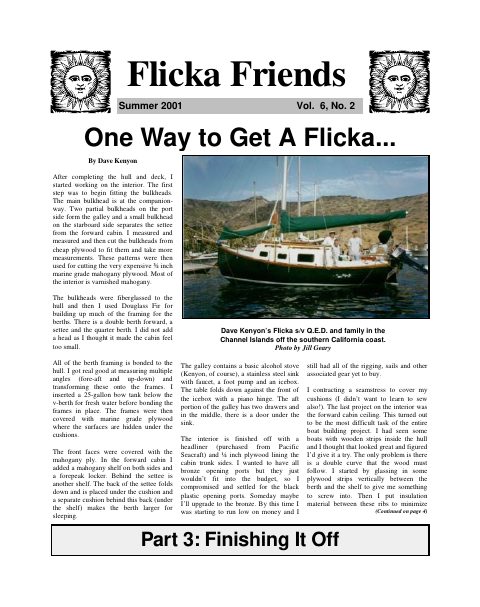
Some time ago, Rod Bruckdorfer asked if I might consider taking on the Flicka Home Page while he was away cruising. This sounded like a good idea and I accepted. Recently, I developed a small web page for Flicka Friends and felt it was time to take over the Flicka Home Page.
After a couple of real long weekends, most of the pages were converted from the software that Rod used to the program used to develop Flicka Friends. While the look is different, the information is the same. The biggest change is the use of the YAHOO Flicka 20 Group as a discussion board. The web addresses are listed below.
http://www.nmo.net/~flickafriends/index.html
http://www.nmo.net/~flickafriends/mainpage/index.html
About 400 sets of plans were sold. According to Bruce Bingham, many Flickas can be found in New Zealand Australia and Sweden. A number of hulls were built by Nor’star and some were completed by Westerly Marine. The manufacturer of the bulk of the class is Pacific Seacraft Corporation who built more than 430 hulls in California. Flicka Friends is published on a quarterly basis, with issues being mailed in March, June, September and December. Articles, letters, comments and photos relating to the Flicka are welcomed and encouraged.
Copyright 2001 Dennis Pratt/Flicka Friends Dennis Pratt - Publisher 685 Spring Street, #191 Friday Harbor, WA 98250 (360) 370-5133 scamper@rockisland.net Tom Davison - Editor P.O. Box 922 Sutton’s Bay, MI 49682-0922 (231) 271-5111 flickafriends@nmo.net http://www.nmo.net/ ~flickafriends/index.html One way to get a Flicka... any condensation. So far so good. I selected maple for the wood ceiling and cut it into strips about 1.5 inches wide and maybe 3/8 inch thick. I started with the strip just beneath the shelf and managed to get that screwed in, however, each successive piece had more and more curve and it was getting tougher and tougher. Once I couldn’t get them to curve into place I decided I needed to steam them. That sounds easier than it is (these are about 6 or 7 feet long). I couldn’t get them sufficiently steamy to bend enough so I decided to try boiling them. I bought a piece of gutter, bent it up at the ends, filled it with water and then put it over a fire. One at a time I boiled the pieces of wood and then when they were sufficiently cooked, I screwed them into place. This actually worked pretty well and I was proud of myself for having figured this out. Until I realized that after it dried, the wood shrank back to its normal size, leaving little gaps between each strip. Oh well, my ceiling has some small gaps, actually it doesn’t look that bad. I finished it off with about a zillion plugs to hide the screws and lots of coats of varnish.
Forward Berth Framing – This is the roughed-in framing for the v-berth showing the partial bulkheads on either side, the bow tank and the forepeak bulkhead.
Let’s see, by now I have moved the boat several more times and now live in Chester Springs, PA. The last tasks involved buying lots of hardware, rigging, spars sails and all the necessary paraphernalia required to go sailing. I bought the gaff rig spar kit from Pacific Seacraft and learned how to tap threaded holes into aluminum. I also learned how to put Sta-Lok fittings onto the wire stays and shrouds. If nothing else, building a boat is a learning experience! I even learned that the cheapest sails are made in Hong Kong (I am almost totally broke by now). So I ordered the sails (a gaff main, a clubfooted staysail and a working jib) from Sails East, Inc. Unfortunately, they were delivered on a slow boat from China and
Finished Forward Cabin – This picture shows the completed forward cabin, complete with the maple ceiling strips. Part 3: Finishing It Off the boat was launched sans sails. Anyway, I managed to get all of the rigging to fit and with a tabernacle mast step, I can raise and lower the rig by myself. Finally, in June 1987, I launched the QED in the Bohemia River on the very northern-most part of the Chesapeake Bay – and it floated. Not exactly where I had put the waterline, but it floated. (For an explanation of the name, QED, see the Flicka Web Page and the Names Link).
Champagne – Well, there’s nothing left to do now except hope that the newly-christened QED floats!
It Floats – Of course, it did float, and (eventually) even sailed! And she’s still sailing 14 years later.
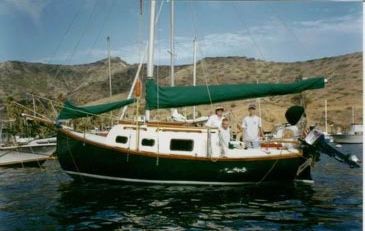
Several weeks later, when I finally received the sails, I found out that it actually does sail too. That summer we took our maiden voyage to a Pacific Seacraft Rendezvous in St. Michael’s Maryland. The highlight of that trip was having dinner with Katy Burke and hearing all of her Flicka adventures with Bruce Bingham. In 1994 I bought a trailer and a truck and towed the boat to Southern California where I lived on the boat in Newport Beach for 4 months before my family moved out. We sailed for 5 years in San Diego, LA, and 2 weeks in San Francisco (where we went to another PS Rendezvous). In 1998 I sailed the QED in the Newport-to-Ensenada race, finishing seventh in the cruising division. When my job brought me back East to Virginia, I once again trailered the QED across the country and now have the boat back in the Chesapeake, this time at Herrington Harbor just South of Annapolis. Actually, the boat is currently out of the water and undergoing a complete refit. It’s amazing how many parts need repair or replacement after 13 years of sailing. My current plan is to get the Flicka shipshape again and then trailer it south this fall for some extended cruising in the Bahamas. At least as long as the finances, the job and my family will allow, but that’s a future story. In the meantime, if you see a green, gaff-rigged Flicka named QED, Wave. My E-mail (at least for now) is: kenyon.dave@orbital.com More s/v Q.E.D. Photos
Forward Cabin Insulation – A small shelf was added on both sides of the forward cabin. Notice the frames in place for the ceiling, the roughed-in forepeak locker and the insulation along the hull.
Settee – This picture of the nearly completed settee shows the cabin trunk sides.
Matt helping – Here is Matt, then less than 2 years old helping on the project. Now he’s bigger than me and almost ready for college!
Unfinished Galley – This is the rough galley lay out with the alcohol stove, the sink and the icebox
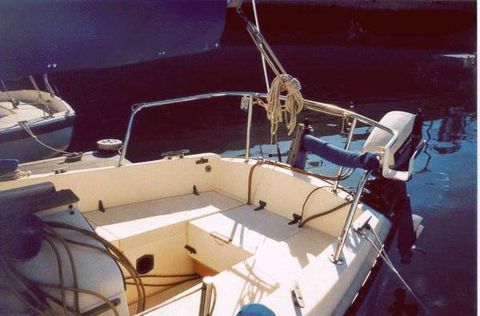
Editor: There is another Flicka hull out there under construction as this is published. The Flicka will have a junk-rig. Hopefully, we will hear from him about his project as it develops. Inboard or Outboard? in the water. The prop is also protected by the hull and the rudder. It is more “yacht” like to have the inboard. The outboard isn't there to clutter up the fine transom of the Flicka. Also, you don't have to hang over the transom to operate the outboard. While you can get remote controls for some outboards, installation would only get in the way of using the outboard on the dinghy. You might be able to say that the inboard diesel makes more sense if you are going to cruise coastal waters and the outboard is better offshore, at least in a pure sense. The outboard would eliminate a number of thru-hulls and the additional hazards relating to more holes in your boat. The diesel would reduce installation problems if you wanted to add a windvane to your Flicka at some point, but the Monitor windvane does fit well on a Flicka with a outboard. A typical placement of an outboard engine on the port side of the transom. Note the fuel tank storage in the cockpit. By Tom Davison One of the fundamental decisions when buying a Flicka is engine choice. A number of comments from various sources have been gathered here. One Flicka owner had a Nissan five horsepower outboard. The five horse was a temporary replacement for a larger nine horsepower outboard. The captain said that the five horsepower outboard was really too small and would barely make it out of the marina if there was any sea running. From another Flicka owner, I've heard that the high thrust outboards models are the way to go. They provide the same thrust at one-quarter the throttle. He feels the outboard to be superior over an inboard for maintenance reasons. It is certainly cheaper to take your outboard engine into a dealer than to have a "diesel" mechanic make a trip to your boat. The outboard can be removed from the water, eliminating the drag from the lower
unit and the prop. With an inboard reducing drag means a folding prop, i.e. expensive $1,000+. Offshore, the reduced drag might mean a few more miles per day. The outboard can be a source of power for your dinghy. With a large enough inflatable, you can move the outboard from Flicka to dinghy depending on your needs. One new aspect of outboard ownership are the beginnings of two-stroke limits. Lake Tahoe has limitations and there have been a number of articles about this. Buying a four-stroke outboard or one of the newer fuel injected two-strokes with a separate oiling system may be the prudent purchase. Theft may be something to consider. Removing an outboard from the transom doesn't take very long, removing a diesel isn’t very likely. The inboard offers a number of advantages. First of all, the prop is much lower
There is also the diesel vs. gasoline argument. In my mind, diesel is much safer. The fuel consumption of a Yanmar is around one quart per hour. The older Flickas had a twelve gallon diesel tank and more recent models have an eight gallon tank. The twelve gallon tank gives a range of approximately 240 miles assuming that you are traveling at five miles an hour (12 gallons x 4 x 5 knots = 240.) It is also nice to reach down to turn a key to start the diesel rather than hang over the stern and pull a cord. You can of course purchase outboards with electric starters. With eight gallons, the range decreases to 160 miles (8 gallons x 4 x 5 knots = 160). There may be one other advantage to diesel power. The small Espar heaters run on diesel. If you live in a northern latitude this heater might make the early spring and late fall trips more enjoyable. The final decision may be just simple economics. An outboard powered Flicka is cheaper than one with an inboard diesel engine. Please add my name to the Flicka Friends and those who are interested in the Bruce P. Bingham design - Flicka. Your name will not be given to any other publication at any time. This publication is not for profit. To start a subscription, send your e-mail address to the Publisher or Editor. You can find their email addresses on page 3. Your e-mail address will be added to the mailing list. Flicka Friends is sent via the internet as an Adobe Acrobat PDF file. The reader for this file is available (free) on the internet. Thank you very much. NAME
___________________________________________
___________________________________________
_______________________________________ STATE ___________ZIP__________
E-MAIL ______________________________________
Hull Number _______ Boat Name ______________________
“Flicka Friends” © 2001 by Dennis Pratt. All rights reserved, except for information that may have a prior copyright used here by permission.
Dennis Pratt 685 Spring Street, #191 Friday Harbor, WA 98250