Flicka Friends · Volume 6, Issue 1

Spring 2001

16 pages · edited by Tom Davison · contributions from Rod Bruckdorfer, Tom Davison

Download the original PDF — scanned exactly as published

In this issue

  1. Flicka Performance Under Sail — Rod Bruckdorfer (p1)
  2. The Missing Jib — Tom Davison (p2)
  3. The Weather Legacy of Admiral Sir Francis Beaufort--Keith C. Heirdon, PhD, ACM (p4)
  4. The Beaufort Scale and the Flicka — Tom Davison (p2)
  5. Flicka Displacement — Tom Davison (p7)
  6. Table--The Beaufort Scale and Flicka Sail Selection-T. Davison
  7. Table--Flicka Sail Area and Sail Balance — Tom Davison (p12)
  8. Table--Sail Area vs. Displacement — Tom Davison (p2)
  9. Table--The Flicka's Sail Carrying Ability — Tom Davison (p14)
  10. Table--The Flicka's Heal Angle — Tom Davison (p15)

Flicka Performance Under Sail

By Rod Bruckdorfer · page 1 · Spring 2001

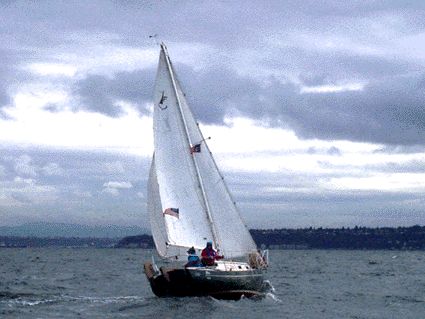
Reviewed by Charlie Dewell When people ask, “How well does a Flicka sail?”, there are two common replies. “A Flicka can sail faster than 6 knots” and “They can not sail out of their own way.” Both answers are correct, depending on the wind speed and sea conditions. A better answer is; “The Flicka can easily sail at 4 to 5 knots and on a reach she sometimes exceeds 6 knots, but in light air a drifter is a plus.” The key to sailing a Flicka is to understand that her stability is derived from her ballast. She has a wineglass shaped cross-section and as the wind speed increases the Flicka wants to heel. As the boat heels, weather helm is induced and the sail plan’s center of effort must be moved forward in relation-ship to the center of lateral resistance to balance the boat. Once these concepts are mastered, the Flicka is one beautiful sailing machine for her diminutive size. Under sail, the boat is initially tender because of her wineglass sections. Going to weather in light air she heels to about 10 degrees. As wind speed increases, she will assume 15 degrees of heel and in dirty conditions the angle of heel is between 15 and 20 degrees, depending on wind strength and the amount of canvas one is comfortable flying. The key to working a Flicka to weather in winds equal to or greater than 20 knots is to set enough canvas aloft so she heels to 20 degrees. As she heels,

1983 Pacific Seacraft Flicka s/v KIRI, Hull #241 Home Port; Shilshole Bay Marina, Seattle, Washington the moment of the sail plan’s center of effort is moved outside the boat. When this occurs, the Flicka develops weather helm quickly. The solution is to tuck a reef in the main to balance the helm - two fingers on the tiller. The one exception to this rule is when a 135% genoa is flown. The genoa moves the center of effort aft and induces weather helm as the boat heels. The solution is to reduce the headsail area by changing sails or using the roller furling gear. In 15 to 20 knots of wind, speed to weather is 4 to 5 knots, depending on sea

conditions. In 30 knots of wind or higher she will work to weather at 3½ to 4 knots. The tack-to-tack angle is between 110 and 120 degrees. Tacking the boat can sometimes be a challenge. Because of her full keel and forefoot, she comes across the wind similar to any boat with a full keel. Compared to a fin keel boat or a boat with a cut-away forefoot, she tacks slowly. In most conditions, when the seas are moderate, the Flicka tacks easily and on command. When the seas become “dirty” and a 3 to 4 foot chop is running, tacking can sometimes be a challenge.

This issue represents research into fourteen different sail combinations for the Flicka. The goal was to show how the various sails relate to one another, to the Flicka and for various displacements of the Flicka.

The Missing Jib

By Tom Davison · page 2 · Spring 2001

It IS NOT my suggestion that all of the sails be purchased or carried aboard your Flicka. This would certainly break the bank for most owners and reduce the cabin to something similar to the “sewer”

of an American’s Cup yacht. My original goal was to publish this issue with approximately 30 photos of each sail combination and under the corresponding wind force. That was not to be and the decision was made to present the just the information. Please forgive the text book presentation. I would like to post this issue as a series of web pages. If you would like to submit a photo of your Flicka under sail, it will aid me with completion of this internet project on the Flicka Home Page. Thanks!

The Weather Legacy of Sir Admiral Beaufort

The Weather Legacy of Admiral Sir Francis Beaufort--Keith C. Heirdon, PhD, ACM

Flicka Friends · page 4 · Spring 2001

BEAUFORT WIND FORCE SCALE Admiral Robert Fitzroy of H.M.S. Beagle fame wrote of Admiral Sir Francis Beaufort, "All honor to Beaufort, who used and introduced this succinct method of approximation by scale..." The method to which Fitzroy refers, one of Beaufort's many accomplishments during his distinguished naval career, is the Wind Force Scale, still in widespread use today by men of the sea. Francis Beaufort was born in 1774, in County Meath, Ireland, the son of the Reverend Daniel Augustus Beaufort, the Rector of Navan. At the tender age of 13, he began his nautical career as a cabin boy in the British Navy. Three years after going to sea, Francis Beaufort recognized the value of being weatherwise and began keeping a meteorological journal in the form of brief comments on the general weather scene, a practice he would continue until his death. And at 22, he had risen to the rank of lieutenant, serving aboard H.M.S. Phaeton. In 1805, Beaufort was given his first command, H.M.S. Woolwich, and assigned to conduct a hydrographic survey of the Rio de la Plata region of South America. During these early years of command, he developed the first versions of his Wind Force Scale and Weather Notation coding, which he was to use in his journals for the remainder of his life. Injury Leads to New Career Beaufort's assignment during the years 1811 and 1812 led him to the Eastern Mediterranean off Asia Minor for a combined hydrographic study and patrol mission against the pirates operating out of the Levant. In June, 1812, Beaufort sent a survey party ashore to make astronomical observations. When the party encountered armed hostilities from the local pashas, Beaufort himself led the rescue. As they were rowing back to H.M.

S. Fredrikssteen, Beaufort was struck in the groin by sniper fire. The ball fractured Beaufort's hip, and he subsequently spent several months convalescing aboard ship. By the end of the year, however, it was obvious that both ship and commander were in great need of repair, and they were ordered home by the Admiralty. Francis Beaufort would never again return to active sea duty although he would remain in the British Navy until he was 81. In 1829, Beaufort was appointed Hydrographer to the Admiralty. From this post, he outlined the hydrographic studies for many British expeditions including that of H.M.S. Beagle, commanded by his protégé Robert Fitzroy. In 1838, Beaufort's Wind Force Scale was introduced for use by the British fleet

for all log entries, joining his Weather Notation, which had been prescribed for use five years earlier. The Admiralty promoted Beaufort to Rear Admiral in 1846. Beaufort was bestowed the title Knight Commander of the Bath two years later. In 1855, after 68 years of service, Sir Francis retired from the Admiralty. He died in 1857, but his life's work continued to receive recognition and honor. Of his many achievements, Admiral Beaufort is remembered today most for the Wind Force Scale which now bears his name. The scale, which he conceived in 1805 and the British Navy adopted in 1838, however, underwent major changes in the 100 years following it initial adaptation. In his journal for January of 1806, then-Commander Beaufort wrote, "From now on I shall evaluate the force of

Use with All Due Caution Admiral Sir Francis Beaufort the wind in accordance with the following scale, since nothing gives a more indefinite repre-sentation of the wind and the weather than the previously used expressions like moderate wind or cloudy weather." Originally, the Wind Force Scale consisted of 13 degrees of wind strength, from calm to hurricane, and was based upon the effects of various wind strengths upon the amount of canvas carried by the fully rigged frigates of the period. In the days before elaborate meteorological instruments, Beaufort had chosen for his wind sensor the prime ship of the British fleet. The 1831 version of the wind scale as outlined in a memorandum to Commander Robert Fitzroy could be divided into three sections. The first five states (Forces 0-4) described a ship's speed with all sails set and clean full, and in smooth water. The next five (Forces 5-9) concerned the ship's mission, the chase, and its sailcarrying ability. For example, in a fresh gale (Force 8), a well-conditioned man-ofwar could just carry in chase, full and by, treble-reefed topsails, etc. The final three Forces (10-12) referred to a ship's ability to survive whole gale, storm, or hurricane.

international use in meteorological telegrams, changes were needed. Refinement of the Beaufort Wind Scale Since the frigate was no longer the dominant ship on the seas, a new "probe" was necessary to determine the wind's force. The original Beaufort force numbers were now subtly changed so that they referred to states of the sea or degrees of motion of trees instead of the sails on a frigate. But ambiguities soon arose, for the state of the sea also depends upon swell, fetch and water depth, and trees vary in their response to the wind. Finally, in 1946, the International Meteorological Committee, extending the scale to 17 values (the added five values further refining the hurricane-force winds), defined the scale values by ranges of the wind speed as measured at a height of 10 meters above the surface for each Force Number. In effect, this transformed the Beaufort Wind Force Scale into the Beaufort Wind Speed Scale. The Beaufort Weather Notation Code As Francis Beaufort rose in rank, his weather journal entries became a regular part of his daily routine, ultimately increasing in frequency to observations at two-hour intervals.

In 1838, the British Admiralty officially prescribed the Scale and made its use mandatory for all ship's log entries, for, as it was defined, the Scale had no ambiguities for the sailors and officers of the day.

To describe the state of wind and weather accurately but briefly, Beaufort devised a system of notation that was to become the forerunner for modern weather-observation codes.

But the winds of change move ever onward, and like Beaufort himself, the frigate eventually passed from the scene as the prime ship of the British Navy. Thus, when the Permanent Committee of the First Meteorological Congress met to adopt the Beaufort Wind Scale for

One part of this observation notation was the wind force number from his Wind Force Scale. The second part of the code was a series of alphabetic symbols of one to three characters which described the state of the sky and weather, differentiating between types of precipitation

and cloud conditions. Between 1806 and 1832, Beaufort further refined his original coding scheme. For example, in the 1806 designation, Beaufort used f to indicate fine weather. In the 1826 version, this notation now represented fog. With slight alterations, the Beaufort Weather Notation was adopted by the British Navy in 1833. Nearly a century later, the British Meteorological Office adopted the code for use, again with only slight alterations such as adding intensity indicators (e.g., the use of the upper rather than the lower case to indicate high-intensity precipitation). An international conference meeting in Warsaw, Poland in 1935 officially approved a form of the Beaufort notation for international exchange of weather observations. [Table of Beaufort's Weather Notation adopted by these agencies.] Today, numbers have generally replaced alphabetics for the reporting of general meteorological observations, except for some specialized reports where letter notation is still used to indicate weather and cloud conditions. And direct measurements have replaced the estimates of the Wind Force Scale. The new forms, however, do not hide the legacy of Sir Francis Beaufort as landsmen and sailors alike continue to describe the ever-changing sea and the ever-present wind.

My thanks to Keith C. Heidorn, PhD, ACM and the Weather Doctor for allowing Flicka Friends to reprint this article. (http://www.islandnet.com/ ~see/weather/doctor.htm) The Beaufort Scale By Tom Davison Flicka Sail Selection

Several years ago, I decided to take a look at the Flicka’s sail inventory. A number of articles and books covering sails and their selection were reviewed. While there were many sources of information, one of the best publications was The Best of Sail Trim, edited by Charles Mason. This is a collection of articles relaing to sail use which have appeared in SAIL Magaine. Several articles seemed to provide a means to answering the question about selecting sails; •

When to Shorten Down Calculating sail-carrying ability Gabriel M. Giannini Wind Strength and Sail Area How to determine optimum combinations. Arthur Edmunds Which Headsail When?-Systemized sail changing Richard du Moulin

After reading these articles, I decided to examine the sail area and sail combinations for the Flicka at given wind speeds. Based on the Beaufort Scale, a number of reference tables were created. They helped me develop an overall picture of how sail area effects a Flicka. Looking at these tables and figures, please remember that they are based on math and you must connect these numbers with real sailing. While there are racers who put up spinnakers for a downwind leg in winds that would make most of us a weak in the knees, my sailing is a much more reasonable. Researching the various sails for the Flicka took less time than expected. There were advantages and disadvantages for each sail size, design, fabric weight and sail loft. The basic sail plan for the Flicka is:

Flicka Sail Specifications Total Sail Area

SAIL SELECTION TABLES Now that all of the sails have been described, I turn your attention to the tables in this issue of Flicka Friends. At times, you may wish for just a mainsail, a working jib, two halyards, and the three necessary sheets. That would certainly simplify my sailing, but I would also travel slower. I’m sure that many of you would feel that all of this information gets in the way of sailing. Maybe so, but this research does provide relative information about the performance of a Flicka and should flatten your learning curve. The tables allow you to consider various sail changes in certain wind conditions. The other advantage of these tables is that they show an overlap for several sails. These redundant sails might be eliminated from your sail inventory, freeing up space onboard and simplifying my already complicated sail system. The tables include: •

BEAUFORT SCALE This table shows the system that was developed by Sir Francis Beaufort in the late 1800’s.

SAIL COMBINATION & BALANCE This chart shows the various sail combinations that are possible using the ten different sails aboard my Flicka. Keep in mind that this table shows the combined area and sail balance for all of the sails for the Flicka. The number represents a simple computation based on the percentage of

Use with All Due Caution And The Flicka the total sail area that each sail provides. Obviously, some of the combinations are not practical in actual sailing conditions. I’m sure that flying a spinnaker with a storm trys’l would certainly make people wonder what you were thinking. •

SAIL AREA & FORCE After looking at the various sail combinations, the force generated at each Beaufort Force was computed. While the math was done for all the combinations in each Beaufort Force, it should be very clear to all that many of these sail combinations produce too much force for sailing a Flicka safely. They are presented mearly as an example of the extreme forces sails can generate. Flying a full main and a spinnaker in anything other than the lowest Forces is foolhardy at best. If your Flicka wasn’t instantly knocked down, the light sails would blow out at the higher wind force levels. Flicka Sail Selection Tables
The Beaufort Scale and the Flicka

By Tom Davison · page 2 · Spring 2001

The Missing Jib By Tom Davison Hunter Davis noticed a real gap in Flicka sail coverage during his trip up the Inside passage north from Seattle, Washington to Ketchikan, Alaska. Looking over the tables in this issue confirms his observation. There is a real gap between the Storm Trys’l / Storm Jib combination and the next sail selection. You jump from 66 square feet to 148 square feet. This is an

Flicka Displacement

By Tom Davison · page 7 · Spring 2001

See descriptions on this page for more detail. •

HEALING ANGLE & SAIL AREA The effective sail area decreases as a sailboat heals over before the wind. At higher angles of heal, it makes more sense to reduce sail to travel at a shallower angle of heal. This table gives you relative sail areas based on various healing angles for each sail combination.

SAIL AREA vs. DISPLACEMENT Since the displacement of Flickas is not constant, the sail combinations mentioned in this article provide varying ratios. This table provides the sail area to dispalcement ratio for Flicka displacements ranging from 4,500 pounds to 6,500 pounds.

SAIL CARRYING ABILITY With all of the infomration provided in the various charts, this last chart should begin to make sense of the math. This table does not separate the sail recommendations based on the varying displacement. There are two reasons for not creating such a table. First, it would require another four pages and this issue is already a little long. Second, it leave the final selection of sails to the captain. Sailing a Flicka is mor than a series of mathimatical calculations and even with eight pages of tables, the decision to fly what ever sail combination remains with the captain.

THE CUTTER RIG The cutter-rigged Flicka has an advantage over the sloop rig. The stays’l is 60 square feet and with a double reefed main of 58 square feet, brings the total sail area to 118 square feet. This fits nicely between the double reefed working jib/double reefed main and the storm jib and storm trys’l. The combination is also evenly balanced fore and aft. Using the stays’l moves the headsail away from the bow as well. The cutter rig is the best choice. Since using the stays’l is always an option, it allows even more sail combinations. That data will wait for another issue of Flicka Friends. FINAL COMMENTS Please keep in mind that the data in these tables represents the math behind using various sail combinations on a Flicka. As such, you will need to try each sail combination to see just how it works aboard your particular Flicka. Remember that the varying displacement of the Flicka over the years combined with the variable weight of the equipment aboard will figure into your sail selection. Your sailing style and experience also play an important role in the sails combination selected for a given condition. You may or may not agree with the figures and the sail recommendations. Any thoughts or comments relating to this article would be welcomed. If nothing else, this article will open up the a lively discussion about sail use aboard the Flicka. The best Flicka forum on the internet can be found at: http://groups.yahoo.com/group/Flicka20 Flicka Displacement By Tom Davison The displacement of your Flicka will have an effect on the amount of sail you carry. This is just simple physics. The more something weighs, the more effort is will take to move it. Looking at the displacements on the Pacific Seacraft sales brochures, an empty Flicka’s displacement can be anywhere from 4,500 to 6,000 pounds. Home built Flickas could be much lighter, if the hull is built lighter and the keel weight is reduced. I know of one Flicka with only 1,500 pounds of ballast. Flicka Displacement 1972 - Bingham

Obviously, a Flicka loaded down for an ocean crossing will perform differently than one that is out for an afternoon sail. The heavier your boat, the more sail you will need to carry to obtain the same performance of a lighter Flicka. The Flicka’s displacement has changed over the year from Bruce Bingham’s original plans. The first listing is from an article in the March 1972 issue of Rudder Magazine. Most of the specifications are similar to Flickas produced by Nor’Star and Pacific Seacraft except three; a displacement of 10,000 pounds, 3,800 pounds of ballast and a sail area of 270 square feet. The next information I have is the six part series about building a ferro-cement Flicka. The displacement dropped nearly 50% to 5,500 pounds, with 1,720 pounds of ballast and a sail area of 270 square feet. Pacific Skipper published an article about the Nor’Star Flicka currently owned by Flicka Home Page WebCaptain Rod Bruckdorfer. Specifications were nearly the same except there is three more inches of draft, displacement is 6,500 pounds, ballast is 2,200 pounds, and sail area was up to 400 square feet.

The first article for a Pacific Seacraft Flicka showed a dispalcement of 4,500 pounds and 1,750 pounds of ballast with 250 square feet of sail. Pracitcal Sailor’s February 1982 article had the Flicka’s length over all at 23’ 7”, a displacement of 5,500 pounds, ballast at 1,750 pounds and 250 square feet of sail. An article in SEA’s September 1987 issue placed most of the numbers in the same area as before, except the ballast was now 1,800 pounds. The change in displacement has changed some of the design mathematics. One interesting aspect of the higher displacement is that the motion comfort and capsize ratio improved. Displacement / Ballast Ratio Displacement

* Flicka with crew & cruising gear The displacement change from 4,500 pounds in 1976 to 6,000 pounds in 1990 represents an increase of approximately 33%. Since the sail plan remained the same, the additional weight reduced the effective performance by nearly 22%, something to consider when ordering sails. Note The upper displacement is based on a comment made by Jack Harding about s/v RAPPORT before his passage from San Diego, California to Hilo, Hawaii. While being lifted from a semi-trailer, the travel lift registered a gross weight of 8,000 pounds.

Use with All Due Caution Flicka Displacement Sail Area vs. Displacement Ratio Displacement

The increased displacement of the Flicka might have a positive outcome on the motion of the sailboat. Considering the weight is not additional ballast, this formula may not be valid. Motion Comfort Displacement

The lower the capsize ratio, the better the rating. Anyting under a 2.0 is considered good. The improvement of the capsize ratio made me wonder about the forumla and if the better number was based on the assumption that the additional weight is ballast and not stores. I would suspect that the increase in the displacement during a passage is not an improvement due to the location of the additional weight. Since I’m not a naval architect, these calculations are beyond my skills and the mathematical level of this article.

Flicka with crew & cruising gear Capsize Radio

Displacement / Length Waterline Displacement

The bottom line for all of this math is that Flickas with various displacements will perform differently. The heavier the Flicka the slower it will go with a given set of sails. This statement is so basic, I almost didn’t put it in print. The goal of this Flicka Friends issue was to provide the math to quantify the reason for varying performance and to help Flicka owners make something more than just a guess at sail selection while out sailing and when looking for new sails. The Beaufort Scale and FORCE and WIND SPEED And P.S.F.

Full Main 113 Sq. Ft. Spinnaker 398 Sq. Ft.

Full Main 113 Sq. Ft. Gennaker 259 Sq. Ft.

Full Main 113 Sq. Ft. 150% Genoa 220 Sq. Ft.

Full Main 113 Sq. Ft. 140% Genoa 199 Sq. Ft.

Full Main 113 Sq. Ft. 130% Genoa 172 Sq. Ft.

Full Main 113 Sq. Ft. 120% Genoa 159 Sq. Ft.

Full Main 113 Sq Ft. 110% Jib 133 Sq. Ft.

* NOTE: It should be noted that the sail combinations shown above include a number of combinations that should not be used. The information has been included for illustration purposes and IS NOT a recommendation for use. Read the disclaimer on Page Two for more information.

Use with All Due Caution Flicka Sail Selection FORCE and WIEND SPED and P.S.F.

Full Main 113 Sq. Ft. 80% Jib 106 Sq. Ft.

Full Main 113 Sq. Ft. 100% Jib/1 Rf 90 Sq. Ft.

Main - 1 Reef 78 Sq. Ft. 80% Jib 106 Sq. Ft.

Main - 1 Reef 78 Sq. Ft. 100% Jib/Reef 90 Sq. Ft.

Main -2 Reefs 58 Sq. Ft. 100% Jib/Reef 90 Sq. Ft.

Storm Trys’l 36 Sq. Ft. Storm Jib 30 Sq. Ft.

* NOTE: It should be noted that the sail combinations shown above include a number of combinations that should not be used. The information has been included for illustration purposes and IS NOT a recommendation for use. Read the disclaimer on Page Two for more information.

Use with All Due Caution The Beaufort Scale

Table--Flicka Sail Area and Sail Balance

By Tom Davison · page 12 · Spring 2001

NOTE: It should be noted that the sail combinations shown above include a number of combinations that should not be used. The information has been included for illustration purposes and IS NOT a recommendation for use. Read the disclaimer on Page Two for more information.

Use with All Due Caution and the Flicka Sail Area vs. Displacement MAIN SAILS TO THE RIGHT

Total sail area and performance increase/decrease from 100% (Full Main and 100% Jib) Sail Area/Displacement at Various Displacements of the Flicka 4,500 pounds / 5,000 pounds 5,500 pounds / 6,000 pounds / 6,500 pounds

511 Sq. Ft. - 201% 29.00 / 27.96 26.24 / 24.76 / 23.47

476 Sq. Ft. / 193% 27.94 / 26.04 24.44 / 23.06 / 21.86

456 Sq. Ft. - 185% 26.76 / 24.95 23.41 / 22.09 / 20.94

434 Sq. Ft. - 178% 25.47 / 23.74 22.28 / 21.01 / 19.93

372 Sq. Ft. - 151% 21.83 / 20.35 19.10 / 18.02 / 17.09

337 Sq. Ft. - 137% 19.78 / 18.44 17.30 / 16.33 / 15.32

317 Sq. Ft. - 129% 18.61 / 17.34 16.28 / 15.36 / 14.56

295 Sq. Ft.—121% 17.31 / 16.14 15.15 / 14.29 / 13.55

333 Sq. Ft. - 135% 19.84 / 18.22 17.10 / 16.13 / 15.30

298 Sq. Ft. 121% 17.49 / 16.30 15.30 / 14.44 / 13.59

278 Sq. Ft. - 113% 16.32 / 15.21 14.27 / 13.47 / 12.77

256 Sq. Ft. - 104% 15.03 / 14.01 13.14 / 12.40 / 11.76

312 Sq. Ft. - 127% 18.31 / 17.07 16.02 / 15.12 / 14.33

277 Sq. Ft. - 113% 16.26 / 15.16 14.22 / 13.42 / 12.72

257 Sq. Ft. 15.08 / 14.06 13.20 / 12.45 / 11.80

235 Sq. Ft. - 95% 13.79 / 12.86 12.07 / 11.39 / 10.79

285 Sq. Ft. - 115% 15.78 / 17.54 19.30 / 21.05 / 22.80

250 Sq. Ft. 102% 14.67 / 13.68 12.84 / 12.11 / 11.48

230 Sq. Ft. - 93% 13.50 / 12.58 11.81 / 11.14 / 10.56

208 Sq. Ft. - 85% 12.21 / 11.38 10.68 / 10.08 / 9.55

272 Sq. Ft. - 110% 15.96 / 14.88 13.97 / 13.18 / 12.49

237 Sq. Ft. - 97% 13.91 / 12.97 12.17 / 11.48 / 10.89

217 Sq. Ft. - 89% 12.87 / 11.87 11.14 / 10.51 / 9.97

195 Sq. Ft. - 79% 11.45 / 10.67 10.01 / 9.45 / 8.96

246 Sq. Ft. - 100% 14.44 / 13.46 12.63 / 11.92 / 11.30

211 Sq. Ft. - 86% 12.38 / 11.54 9.45 / 8.91 / 8.45

191 Sq. Ft. - 78% 11.21 / 10.45 9.81 / 9.25 / 8.77

169 Sq. Ft. - 69% 9.92 / 9.25 8.68 / 8.19 / 7.76

219 Sq. Ft. - 89% 12.85 / 11.98 11.24 / 10.61 / 10.06

184 Sq. Ft. - 75% 10.80 / 10.07 9.45 / 8.91 / 8.45

164 Sq. Ft. - 67% 9.63 / 8.97 8.42 / 7.95 / 7.53

142 Sq. Ft. - 57% 8.33 / 7.77 7.29 / 6.88 / 6.52

203 Sq. Ft - 82% 11.91 / 11.11 10.42 / 9.84 / 9.32

168 Sq. Ft. - 67% 9.68 / 9.19 8.63 / 8.14 / 7.72

148 Sq. Ft. - 60% 8.69 / 8.10 7.60 / 7.17 / 6.80

126 Sq. Ft. - 51% 7.40 / 6.89 6.47 / 6.10 / 5.79

143 Sq. Ft. 58% 8.39 / 7.82 7.34 / 6.93 / 6.57

108 Sq. Ft. - 44% 6.34 / 5.91 5.55 / 5.23 / 4.96

88 Sq. Ft. - 36% 5.16 / 4.81 4.52 / 4.26 / 4.04

66 Sq. Ft. - 27% 3.87 / 3.61 3.39 / 3.20 / 3.03

This table was created to show the relative power of a sail combination with five different displacements of the Flicka, a figure that can change up to 20%. The displacements were based on the information contained in the order forms provided by Pacific Seacraft. The percentages shown in each block is the performance compared to a full main and a 100% jib. Possibly the most important aspect of this complicated table is the documentation of how much the incresed dispalcment alters performance. Note that the percentage is based on the performance of the sail combination and not total sail area.

Use with All Due Caution The Beaufort Scale

Table--Sail Area vs. Displacement

By Tom Davison · page 2 · Spring 2001

Since Flickas have many different displacements; sail plans; total sail area; sail selection; sail condition; captain/crew knowledge, skills, ability & experience; and many other factors (incuding wind speed, sea condition, fetch, and others), the responsibility for the safe use of these tables falls upon the captain and crew of each Flicka. Given all of the variables listed (or not listed), the information contained in this issue of Flicka Friends must be viewed as a starting point. You must determine just how close this information is to your particular Flicka, its sails, and to your experience and skill.

increase of more than 100%. He also included a solution to the problem. Use the cutter stay sail in place of the jib. At 60 square feet with a reef available, this fits works perfectly in between the other two sails. The Storm Trys’l / Cutter Jib ends up at 96 square feet. This put the combination squarely between the 66 square feet of the Trys’l/Storm Jib and the 148 square feet of the double reefed main and reefed 100%.

Disclaimer The bottom line it that I have always thought that travel away from developed areas, safety is the responsibility of each member of the party. Not only they must be able to accurately judge their equipment, individual & group skills, they must compare their capabilities against the existing sea and weather condtions. The burden to continue with, postpone or even cancel a trip falls on the shoulders of the captain and each person in the party. Using these tables carefully and with all due care and caution. Now the warnings are out of the way… Have fun & Fair winds and good sailing...

Use with All Due Caution Flicka Sail Performance (Continued from page 1)

Because of her short ends and blunt bow, the boat wants to pitch as the bow is turned into the wind. The pitching motion causes her to lose speed and tacking may become difficult. The key in these conditions is to time the tack in relationship to the chop and do not let the headsail flog, which will contribute to slowing the boat. It may be necessary to let the headsail back as she comes across the eye of the wind. This will push the bow off the wind. Once the tack is complete, as with most full keel boats, she will fall off the wind and come back on tack as boat speed increases. In very trying conditions, it may be necessary to wear round the boat, i.e. to turn the head of the boat away from the wind and gybe her to bring her onto the opposite tack. Reaching in a Flicka is sheer joy. From a close reach to a broad reach she is in her element. Under these conditions, she heels between 10 and 15 degrees, depending on wind strength and is a happy “little ship.” In 15 knots of wind she will reach at 5 knots or better and in 20 knots of wind, the boat will approach 6 knots and sometimes exceed 6 knots as the boat comes more and more off the wind. As with windward work, the Flicka will start to develop weather helm. Tucking a reef in the main balances the boat by moving the sails’ center of effort forward. A second step which may be taken to reduce weather helm is to flatten the main. Attaching a vang/pre-venter from the boom to the boat’s toe rail. In addition to helping decrease weatherhelm, sail chafe on the shrouds is also decreased. A well balanced Flicka under these conditions can be steered with two fingers on the tiller. The Flicka has two sailing weaknesses. One is in wind speeds of 10

knots or less. Under these conditions, a drifter should be flown. With a drifter, boat speed may exceed 4 knots in 10 knots of wind. In 5 knots of wind, the Flicka will sail at 2 to 2½ knots with a well set drifter and the main vanged to the toerail with a preventer. This stops the boom moving in the seaway, which causes the main to lose lift. The second weakness is her short ends and blunt bow. In a steep chop, the boat will sometimes hobbyhorse. This may result from pinching the boat too high into the wind or not carrying enough canvas to drive the boat hard. Footing to weather instead of beating and driving the boat hard will correct this deficiency under most conditions. How well does a Flicka sail? For her size and displacement she is an exceptionally fine sailing machine. She is not only fast for her size, she is seaworthy, has a kind motion and a reputation for keeping her crew safe. In a personal conversation with Bruce Bingham, her designer, I remarked, “I don’t know what you did when you designed the boat, but you created an extremely fast, seaworthy boat.” Mr. Bingham replied, “I did nothing -- I just transferred the lines of the two boats I discovered near Wickford, Rhode Island.” In retrospect, what Bruce Bingham did was to not only give us a fine sailing machine which has stood the test of time, but he preserved a hull form that is part of America’s maritime history. When you sail a Flicka, you are sailing a boat whose lineage can be traced to 1840. Thanks to Rod Bruckdorfer for allowing a reprint of his article.

Flicka Friends is a newsletter written specifically for the people who own, crew aboard, or are interested in the Flicka, a Bruce P. Bingham design. Based on the Newport boats of Block Island Sound, this little ship has been built from various materials since the 1970’s until the present day. Hulls have been completed by home builders using plans supplied by Bruce Bingham. More than 400 plans were sold and many Flickas can be found in New Zealand, Australia and Sweden. Commercial builders of the Flicka include Nor’Star, Westerly Marine and Pacific Seacraft Corporation. Pacific Seacraft (Fullerton, California) has built nearly 450 hulls. Flicka Friends is published quarterly. Articles, photographs and letters are welcome and encouraged. Originally a printed newsletter, this document was converted to an “e-newsletter” and sent out via the internet. This offered several advantages. Most importantly, the newsletter is in full color, a considerable improvement over the black & white photocopies formerly sent out. With the reduced cost, the subscription fees were eliminated. Now, the only cost is the monthly subscription (after the computer, scanner, software and internet service ) is my time. If you would like to be added to the mailing list, please send an e-mail to editor at: flickafriends@nmo.net ©

Copyright 2001 Dennis Pratt Flicka Friends Publisher scamper@rockisland.net Tom Davison Flicka Friends Editor flickafriends@nmo.net

Table--The Flicka's Sail Carrying Ability

By Tom Davison · page 14 · Spring 2001

Force Force Force Force Force Force Force 4 5 6 7 8 9 10 11-16 Kt 17-21 Kt 22-27 Kt 28-33 Kt 34-40 Kt 41-47 Kt 48-55 Kt

It should be noted that the information shown above includes a number of combinations that should not be used. They are included here for illustration purposes only. Read the disclaimer on Page Two for more information.

Table--The Flicka's Heal Angle

By Tom Davison · page 15 · Spring 2001

Use with All Due Caution Please add my name to the Flicka Friends and those who are interested in the Bruce P. Bingham design - Flicka. Your name will not be given to any other publication at any time. This publication is not for profit. To start a subscription, send your e-mail address to the Publisher or Editor. You e-mail address will be added to the mailing list. Flicka Friends is sent via the internet as an Adobe Acrobat PDF file. The reader for this file is available (free) on the internet. Thank you very much. NAME

___________________________________________

___________________________________________

_______________________________________ STATE ___________ZIP__________

E-MAIL ______________________________________

Hull Number _______ Boat Name______________________

“Flicka Friends” © 2001 by Dennis Pratt. All rights reserved, except for information that may have a prior copyright used here by permission.

Dennis Pratt 685 Spring Street, #191 Friday Harbor, WA 98250

Also in this issue

These pieces are in the archive but not yet transcribed — they're in the PDF.

  • Table--The Beaufort Scale and Flicka Sail Selection-T. Davison

Every surviving issue is in the Flicka Friends archive. For the boats named here, see the Flicka 20 registry, or the Flicka 20 specs.