Flicka Friends · Fall 2003 · Vol 8, #3
Delivery of a New Trailer — Tuning the Setup
By Tom Davison · page 10 of the Fall 2003 issue
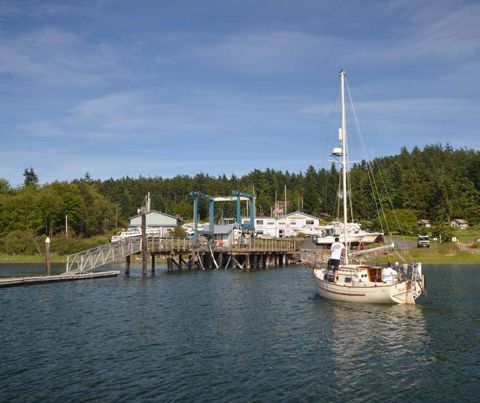
The plan was to lower the mast of the BEN MAIN, Jr, load the Flicka on the new trailer, winterize the engine and head off for dinner. We expected this to take an hour or so. What really happened was a bit different. Instead of a couple hours, it took parts of two days. The bottom line was that the pads were not positioned correctly. Adjusting them in the water was possible, but there was another option. It would also mean moving the Flicka to a boatyard with a travel lift. The downside was that this marina didn’t have a travel lift. There were two boatyards in the area with lifts. One was fifteen miles to the north, the other was roughly the same distance to the south. Since the mast, gaff, and boom were already down on the deck, we would need to motor. The decision was made to motor BEN MAIN Jr. from Suttons Bay, Michigan to Northport, Michigan, the closest marina with a boat lift. The wind was out of the southwest; traveling north would make the trip faster. It was also going to be warmer traveling with the wind rather than against it.
Before leaving, owner Tom Grimes worked on getting all of the standing and running rigging secured. I drove over to the local deli to pick up a late lunch of chili and crackers. This, along with coffee would warm us for the trip to Northport Bay Boatyard. It was October in Michigan and most boats were already out of the water. It was about 2:30 when we cleared the breakwall. The course steered was to clear Omena Point and then turn toward Northport, Michigan. Other than the cold weather, the trip wasn’t difficult. Darker clouds passed to the north, but a few rays of sunlight appeared between the bow and our destination. The entire trip took about three hours and we motored into the small harbor as the light was failing.
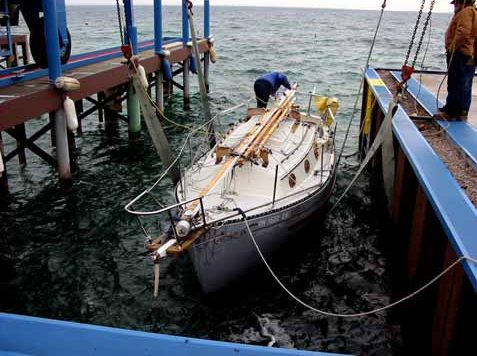
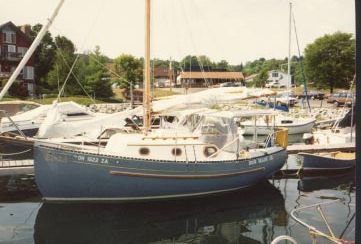
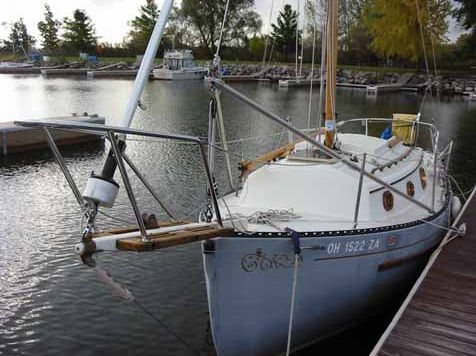
BEN MAIN, Jr. required several attempts to get on the trailer. In the end, we discovered that the support pads were not close to the placement required to properly support the Flicka. Photo: Tom Davison © Tuning the Setup They asked that we use the third slip from the ramp. The harbor was shallow due to the low water level of Lake Michigan. After stopping on the sand bottom twice, we opted for another slip that would accommodate our draft. The dock level was nearly four feet higher than the lake surface. After securing the Flicka for the night, we made plans to be back at 9:00 am.
Advertisement
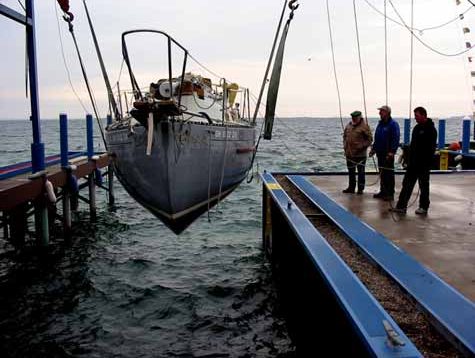
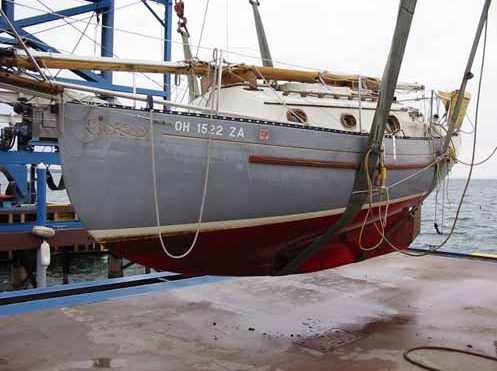
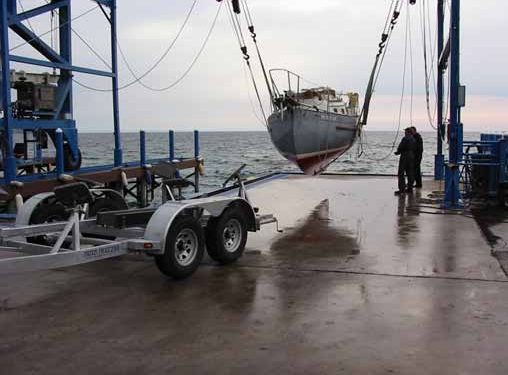
We all returned to the boatyard the following morning and BEN MAIN, Jr. was motored around to their lifting basin. The lake was a bit rough, but the crew was ready for us and the slings were in the water. The crew was skilled and efficient. As we approached the dock, they already had the slings positioned to catch the hull. They positioned them to catch the hull and prevent damage due to the following choppy waves. Only two of the four requested docklines were used and then only for a minute. After a little adjusting, they began raising the Flicka from the water. Within ten minutes of arrival in the lifting basin BEN MAIN, Jr. was raised from the choppy waters of Lake Michigan. Once high enough, the Flicka was moved over to allow placement of the trailer. Before we the trailer was brought over, they pressure washed the hull and began to lower the hull. As soon as BEN MAIN, Jr. approached the trailer, it was obvious that the forward-center pad was much too high. One of the crew immediately stated that the flat pad wouldn’t work and that a v-shaped pad would work much better. The boatyard had a vshaped pad that, after being cut to length and their very casual morning coffee break, fit perfectly.
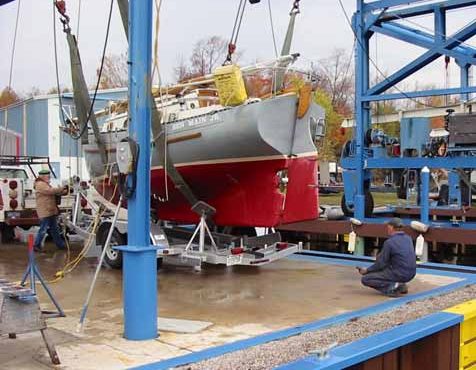
One thing that the boatyard crew complained about was not having sling points indicated on the hull. It was obvious that they would need to move the slings. This appeared to be a common step due to the number and proximity of numerous large blocks of wood. BEN MAIN, Jr. was lowered onto a stack of blocks to allow moving the aft strap into the slot. They continued lowering BEN MAIN, Jr. onto the trailer. As they did, it was apparent that the pads were one foot from they should have been. As the weight settled onto the trailer, they decided to move the Flicka forward on the trailer to get the weight in the correct location. This was based on years (actually decades) of loading boats and looking at how the tires appear under load. The bow stop was moved six inches forward to balance the Flicka on the trailer. Next, the crew centered the Flicka vertically with the slings. They have two lifts, one is a motorized travel-lift that allows them to place a boat on the trailer anywhere in their yard. Instead of using that one, a stationary lift was employed. This appeared to offer a number of advantages. They could move the hull in all planes and put the hull on the trailer carefully and in exactly the desired location
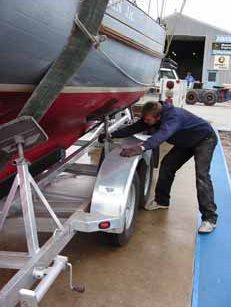
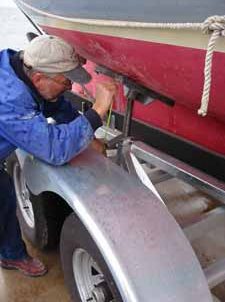
They went to work adjusting each pad to the hull, measuring both sides and then balancing the hull from side to side. After double checking each adjustment, the set bolts on each of the hull support pads were tensioned.
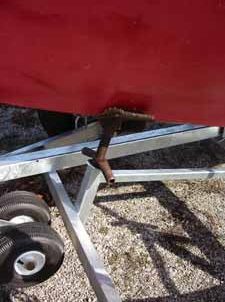
CAUTION The following settings are based on Flicka # 315—BEN MAIN, Jr. While they should be close to other Flickas, the fore and aft placement of the trailer was based on this particular Flicka. It has an inboard diesel engine, an enclosed head, a nearly all rope single anchor rode.
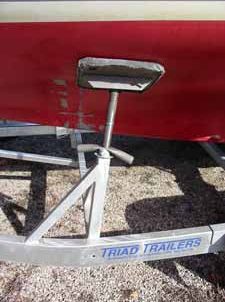
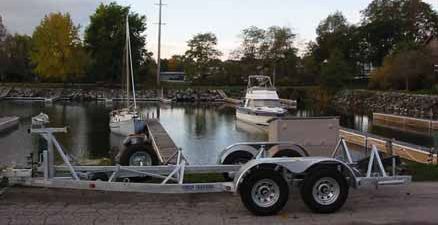
TRAILER BOW STOP When the trailer arrived, the arm was set to the maximum aft position. That put BEN MAIN, Jr. too far aft on the trailer to weight the hitch properly. The bow support was moved forward to the point the boatyard crew felt the Flicka’s weight was correctly balanced over the trailer tires. This adjustment left the bow stop two inches short of fully forward. FORWARD KEEL SUPPORT The original pad provided was flat. When we attempted to load the Flicka the first time, the bow slid to the side one way or the other. When the boatyard viewed this flat pad, they immediately replaced it with a v-shaped pad. The lower portion of the pad screw was too long for the support and they removed the extra length before installation. This will be watched next time the Flicka is loaded. This pad was adjusted fourteen inches from the trailer frame. Note that this measurement along with those to follow are from the trailer frame to the center of the ball pivot of the pad.
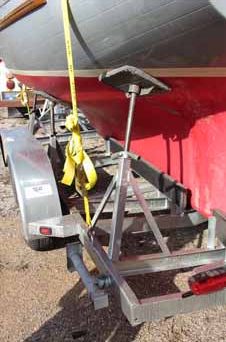
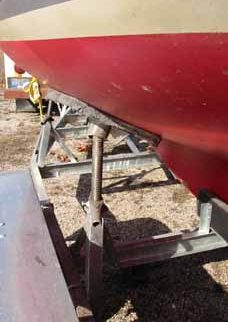
FORWARD SUPPORT PADS Both of these pads were flat and worked well. The only thing required was adjusting them out to meet the Delivery of a New Trailer hull. Their adjustment was measured at twenty-six inches from the trailer frame to the center of pad pivot. CENTER HULL PAD My guess is that the two center pads do the most in terms of centering the Flicka on the trailer. The adjustment is twenty-five inches from the trailer frame to the center of the pivot ball. AFT HULL PAD These two pads required the most change. From the trailer frame to the center of .pad pivot, the measurement is thirty-six and one-half inches. After the lift slings were removed, the rest of the hull was cleaned, followed by winterization of the Yanmar inboard engine and the head. Two large straps were employed to secure BEN MAIN, Jr. to the trailer. After a quick check of the truck, trailer and hitch, BEN MAIN, Jr. was ready for the road.
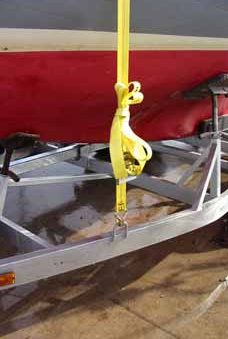
Moving the Flicka down the road to the storage barn didn’t take very long, but the driver took his time and kept the speed to around 45 MPH. Since these were secondary roads, they were less than perfect. The paved road from the boatyard was particularly bumpy, but everything went very well. The barn was perfect for boat storage. After a little jockeying in the barn with the truck, we lowered the caster wheels and pushed the tongue of the trailer toward the wall. After BEN MAIN, Jr. was in the storage barn, there were several other tasks to complete. Triad Trailers recommends the you use the tongue jack and the two jack stands at the aft end of the trailer to take some of the weight of the Flicka from the axles. You should lift the trailer until there is some movement in the axles. This reduces the tension in the torsion bars slightly. The straps securing the Flicka to the trailer were loosened. No reason to leave this tension on the hull.
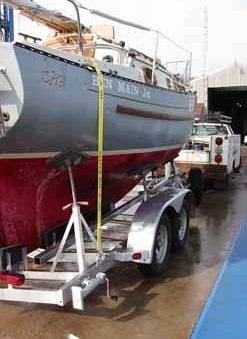
After the trailer was ready to go, the boat yard crew finished pressure washing the full, winterized the engine and the head. All of the other water tanks were empty. Photo: Tom Davison © 2003 Tuning the Setup Don’t get me wrong. The Triad is a very nice trailer. Quality construction is apparent throughout. If you are planning to lift-off and lift-on, the trailer is perfect and nothing needs to be changed. Floating off and on is a different matter. After loading a Flicka on the trailer, there are some improvements that should be considered. The front center keel pad works against loading the Flicka. Changing from a flat pad to a v-shaped pad made a big difference. Instead of helping center the load, the single forward pad allowed the bow to slip to one side or the other.
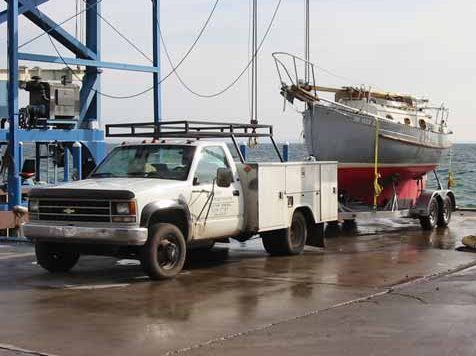
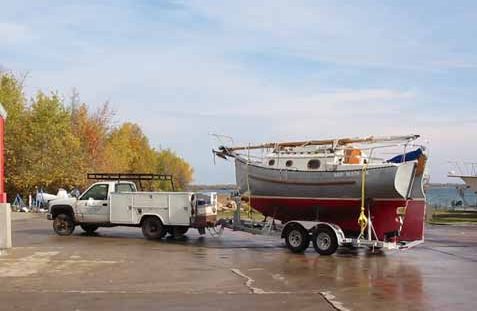
Replacing the single center pad with two lateral pads located in nearly the same location would help the bow find the centerline of the trailer. Rather than the single fixed winch stop, a dual pivoting poly roller stop arrangement would act as a hinge and help the Flicka settle onto the trailer. While there is a small keel guide, it is well below the keel when loading. Something higher and longer would help the keel find the way to the keel pad. The first attempt to load the Flicka resulted in the hull damaging the right board. The repair was easy. Getting the trailer setup for the Flicka should be done with a travel-lift. While it would be possible without one, getting the placement exact is much more difficult. Triad recommends lifting on the first time. I’d have to agree. With BEN MAIN, Jr. in storage, Tom will need to wait until next spring to see how well his Flicka launches. Everything appears to be ready and launching should take a few minutes. The real test will be reloading the Flicka for a trip to the North Channel of Lake Huron next summer.
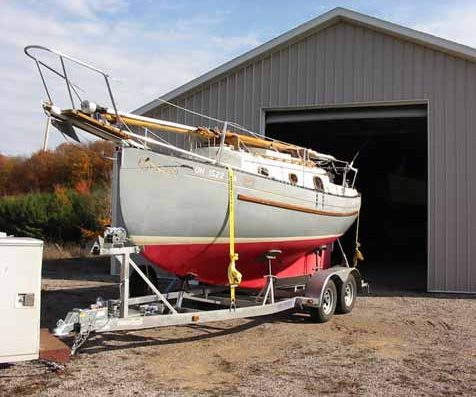
What was the last detail with trailering BEN MAIN, Jr.? It will be months until the 2004 boating season.
Transcribed from Flicka Friends, Fall 2003 (page 10). Read it as originally printed in the PDF, or see everything else in this issue.
Boats in this story
Each links to the boat's page in the Flicka 20 registry.
Advertisement
Next in this issue
Building a Cradle for Your Flicka Rik SandbergMore from the archive
Every surviving issue is in the Flicka Friends archive. Looking for a particular boat? Try the Flicka 20 registry.