Flicka Friends · Summer 1998 · Vol 4, #1
s/v SELECTED RISKS, Voyage of a Pocket Battleship
By Anthony Steward · page 1 of the Summer 1998 issue
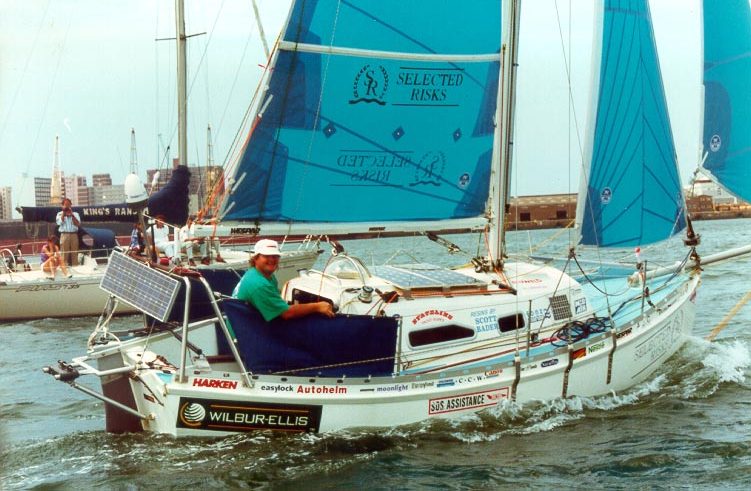
After 260 days of exposure to the elements in a 19 foot open boat, you would think that I would have chosen the easy life. Every man has a right to choose his own oppressor, for me it would be the open ocean. Less than six months after circum-navigating, I was planning my next voyage. There weren’t many options as most records had already been set. I wanted to stay in a small boat as the challenge was greater. I was well aware that Kenichi Horie held the non-stop record in the smallest yacht, a 30 foot sloop. This was always on my mind and now with the advent of reliable watermakers, any size was possible. The only criteria that had to be met was that the yacht would have to be able to carry one ton of supplies and withstand Cape Horn weather. I initially estimated that a 26 foot yacht was the minimum length one could go. That was until I saw a Flicka sailing in Force Six on the South African Coast. On close inspection of this unique little boat, I quickly came to realize a Flicka was equivalent to a 26 foot yacht. My mind was made up, a Flicka it would be. It took less than a month to convince my poor wife that this is what I needed to do as well as find a builder.
The Knudsen family in Durban agreed to build a Flicka for me. I took delivery of the hull and deck in November 1993 and with the help of my long suffering Suzie and friends, we launched SELECTED RISKS at the end of January 1994. One startling difference between the building of my open boat and the fitting out of the Flicka for a non-stop voyage was that there were very few sceptics. Once people had viewed SELECTED RISKS and the preparation we had done, virtually all believed it was possible.
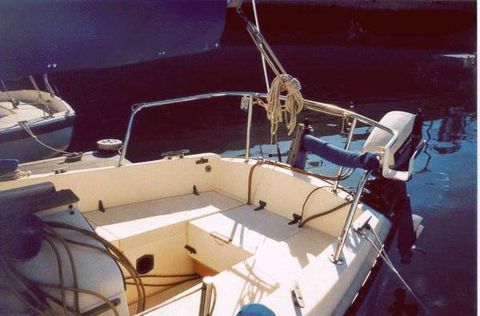
SELECTED RISKS’ first sea trial was entering the Wednesday Night Race in Durban Harbour. The little Flicka's speed was unbelievable and certainly unex-plainable; we easily held off challenges from yachts twice our size. After SELECTED RISKS’ first performance, the Knudsen Family were overwhelmed with enquiries for Flickas; a big pity they had already decided to return to Norway. The key issue on a non-stop voyage is water, with two watermakers installed (each capable of producing 5 liter an hour on three 75 watt solar panels, with a petrol generator as back up) fresh water would be no problem. The wonders of dehydrated and irradiated food still fascinates me. I will never forget my first rounding of Cape Horn in 1987 after forty days at sea eating hot apple pie just like Grandma's. The total weight of supplies loaded was 1.2 tons. Amazingly there was still lots of space. The interior was basic. There was a collision bulkhead at the mast, access being through a waterproof hatch to supplies stored in milk crates bolted in place. The cabin had a single bunk on the starboard side with chart table and galley on the port side. There was no finish. The fibreglass was painted with flow coat, basic but functional. The petrol generator was fitted under the cockpit. The weather dictates departure from Durban, the South African Coast is not to be taken lightly. Southwesterly gales are common and opposed by the fast south flowing current, creates very big steep seas that are notorious for ripping the bows off ships. If one is patient, getting down the coast can be a dream sail. I was not alone, there were three round the world cruisers waiting for the three day weather window to get us past the Wild Coast of Transkei. Once you are off Port Elizabeth, you are safe as the current parts company with the coast and there are quite a few safe anchorages. Finally a big enough window arrived on the February 26, 1994. At short notice, I was saying goodbye to friends and my wife who had now come to terms with the fact that she would not see me for over a year. A light easterly made an enjoyable start to the voyage with SELECTED RISKS clocking five knots with the genoa poled out. To keep me company was an ex-forty foot racing yacht with a Swiss sailor and a forty five foot cruiser with a German family. The first 270 nautical miles was the most worrying, as this constituted the Wild Coast with absolutely no safe havens. The easterly prevailed with a maximum of 25 knots. The Flicka revelled in these conditions even though fully laden.
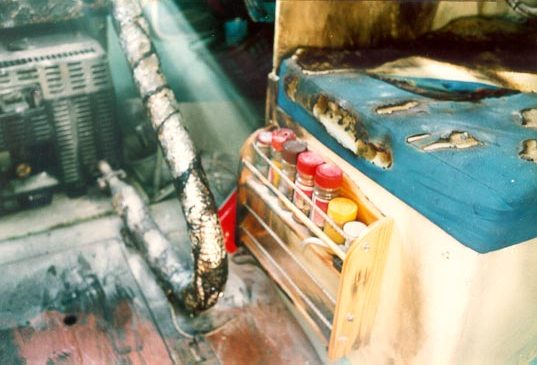
Thirty-six hours later we were off East London, an average speed of 7.5 knots. At times, we logged 9.2 knots across the ground as we picked up the centre of the current. I radioed East London for a weather report and a chat. My cruising companions joined in, refusing to believe my position as this put me in front of both of them by 5 and 10 nautical miles. Roger, the Swiss sailor refused to accept that a 20ft boat could be ahead of his ex-racer. The best thing was that I had been sailing conservatively! Four hours later, Roger managed to pass me with his spinnaker up! Although the weather had been kind it was not plain sailing. Of grave concern was the low batteries obviously caused by a short which I had not been able to trace. Added to this, a generator that refused to start, I decided to anchor off Port Elizabeth with the intention of solving the problems and getting the batteries back to full power. The rules are specific concerning non-stop voyages, you can anchor and repair but no outside assistance is allowed. I will never forget the incident when Olivier De Kersauson on his sixty foot Tri-Marran pulled into Cape Town to effect repairs on his non-stop voyage. I helped him get underway out of the confines of the harbour and this led to the fastest non-stop solo voyage not being recognized. A terrible price to pay for such a minor indiscretion, but rules are rules. I left Port Elizabeth confident that electrical problems were a thing of the past. The 280 nautical miles to Cape Agulhas were uneventful in a following breeze of 10 - 25 knots, we averaged 5.6 Voyage of a Pocket Battleship knots. For this leg I utilized a 200% Genoa. Flown off the bow sprit and with the main stowed, SELECTED RISKS tracked superbly. I have found it takes me five days to become fully attuned to the ocean environment. I now felt at home. This reminded me of my open boat voyage and how much I enjoyed being isolated. Africa does not allow you to escape her claws that easily. Off the shallow Banks of Cape Agulhas, I experienced the first real gale of the voyage. A forty-five knot westerly kept us hove to off Agulhas for thirty six hours I don't think SELECTED RISKS even noticed. Once the wind veered to the south I set course for the Cape of Storms as Cape Point was named by Bartholomew Diaz 500 years earlier. In all my years of sailing, this turned out to be my best rounding of the Cape, flat seas and no wind. We were becalmed for over thirty hours with the Cape in full view. A harrowing time with trawlers and ships charging everywhere with no regard for my little Flicka. I was unable to sleep. Its amazing how man turns out to be your biggest danger at sea. With a rocket flare in one hand and the radio in the other, I kept vigil. What a relief when the breeze filled in from the southwest. A rendezvous had been arranged off Cape Town to hand over an article and photographs to a local magazine. This had me writing furiously as Cape Town loomed. The first major hurdle past, my mind was firmly on the Atlantic high which forces you to sail way to the north before turning west. I had heard that Flickas could set unbelievable passage times once on the open ocean; a figure of 133 nautical miles had been suggested by someone in the know, but nobody believed this in Durban. SELECTED RISKS with 1.2 tons of supplies was about to substantiate this claim. With the 200% genoa and a poled out stay sail the first five days, from Cape Town set distances from a lowly 119 nautical miles to an unbelievable 137 nautical miles in twenty four hours. Thank goodness, I photographed my GPS otherwise they would still be calling me a liar. How do you explain to a racing yachtsman that a 20 foot heavy displacement traditional yacht has been able to do this? I still haven't managed to remove their frowns. History repeats itself. I was back to a low power situation which totally alluded me. I could not pinpoint the problem. I thought I had solved it by rewiring the auto pilot in Port Elizabeth which worked but now I was back to the same situation and after checking every lead and point I could find nothing wrong. Added to my woes was the generator refusing to start. At sea I find one develops amazing abilities to overcome problems because you are so focused and there is no distraction but the worst is frustration when you can't find the problem. My biggest concern was to keeping some power in the 110 amp. hour batteries because if they became too low it would be impossible to recharge with the solar panels and the small generator I had. I knew the petrol generator was a mistake from day one, but the price of a diesel one was way beyond my funds, so I had had to make do. What I am about to write is a great embarrassment to me as a professional sailor. It highlights the stupidity of ignoring safety to solve a problem. I hope that people will learn that it is not worth it to break fundamental safety rules. I stripped the generator of all its protective covers and after four hours of work finally got it started which was such a huge relief as now I could keep the battery charged up. After half an hour of running, I realized the fuel was low but was loathe to turn it off. I attempted to fill the tank in a rolling sea from a five gallon drum with the generator still running. I was exceptionally careful and am positive I did not spill, but still it went up in flames. We built the boat to be totally watertight to survive being capsized off Cape Horn. The only exit was a 3 foot by 3 foot watertight hatch and the generator was placed directly below. I actually used it as a step to exit and enter. I was trapped below with the flames completely covering my exit. Panic I did because the flames and heat started to quickly overwhelm me. Thank goodness the fire extinguisher had been mounted on the forward bulkhead, otherwise I would have definitely burned to death. How long the fire lasted I actually don't know. It was most probably a few seconds but the damage was complete. I suffered burns on my hands and arms. I think this was from my initial reaction in trying to put the fire out with my hands. My hair caught alight from the burning insulation but I only noticed this once the fire was out and I was recovering in the cockpit. I am still not clear on how long it took me to reach St. Helena Island, whether it was four or five days. That was the type of daze I was in (they didn't give me an entry stamp in my passport so this hasn't solved my mystery). I was in great pain from the burns and could not go below because the fire extinguisher powder was everywhere, I could not breathe as the powder choked me. The St. Helenians are familiar with us crazy yachts-man and took great care of me until I could take a ship home. Writing this article makes me deeply sad as I know we would have succeeded if it wasn't for my stupidity. The Flicka is deserving of holding title to the smallest non-stop circumnavigation. I can only apologize to all Flicka owners that the record is not held by a Flicka as this amazing little "Pocket Battleship" would have easily done it.
Advertisement
Transcribed from Flicka Friends, Summer 1998 (page 1). Read it as originally printed in the PDF, or see everything else in this issue.
Boats in this story
Each links to the boat's page in the Flicka 20 registry.
Advertisement
Next in this issue
Bristol Boats Bill StropMore from the archive
Every surviving issue is in the Flicka Friends archive. Looking for a particular boat? Try the Flicka 20 registry.