“Let's sail to Bermuda” “Oh, OK.” replied my wife and shipmate. With those simple statements, the pilot charts for the Atlantic were dusted off and we looked at the charts for May, June and July. Based on wind roses, frequency of hurricanes and sea states projected by the pilot chart, June was selected as the best time to make the passage from the Chesapeake to Bermuda. According to the compilation of data displayed before us, the winds would be Force 4 (11 - 16 knots) and mostly out of the south and southwest with wave heights of 4 feet. I would gun khole from Baltimore, Maryland to the mouth of the Chesapeake, then either beam or close reach to Bermuda where my wife would join African Moon for the passage back. We set our sailing date for the week of June 1st and wrote down our punch list to prepare the boat for “the voyage” which we had dreamed about when we rebuilt African Moon between 1989 and 1994.
first gremlin visited me - a bad main camshaft bearing. I consulted with the local guru's at the “worker's lounge,” the outdoor deck overlooking our marina. ‘That's a $10 bearing you can find at any bearing shop.” After few days wait to have the bearing shipped and $50 later, a very kind retired aircraft mechanic showed me how to press the camshaft assembly and housing together. H e w a s pleased to pass along his years of knowledge and I was grateful for the help but we still lacked one part, a $14 nut. After about a week's wait, the nut arrived from Germany. We moved our sailing date again and thought, “Bermuda here we come.” Lesson One was never, never say, “No Problem.” The engine was assembled in text book fashion. Now for the test, the engine started after a few cranks but lacked power and would not idle. I re-checked the valve clearance then searched all over to ensure I had not left any parts out. I checked the compression by turning the engine over with the hand crank. Either the farm had done wonders for my physical conditioning or the engine lacked compression.
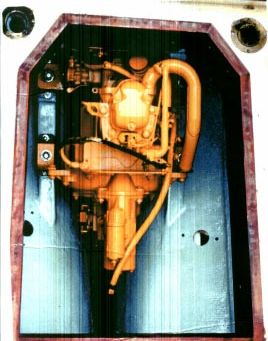
The first item on “The List” was My wife suggested, I check the to replace the leaking oil seal on latter. Yep, no compression and the camshaft of the boat's 22 year more frantic searching to see if I old 6 HP Farymann diesel. had left the head gasket under an According to the Farymann oil stained rag. Based on past mechanic, “No Problem.” Little experience, I suspected the intake AFRICAN MOON’s Bright Yellow did we know, hidden within the valve was not seating correctly 6 HP Farymann Diesel Engine engine was a gremlin which and removed the intake manifold. would test our patience and Sherlock Holmes would have provide us with an opportunity to complete a self-taught course been proud, besides my intuitive deduction, the intake manifold in Diesel Mechanics. It also taught us a valuable lesson in was coated with soot and when the engine was hand cranked, preparing for an ocean passage. blowback was detected. After returning from helping my wives parents on their farm, I started work on the engine the 2nd week in May. “No Problem,” I disconnected the water hoses, fuel lines, disassembled the intake and exhaust manifolds, removed the valve rockers and pushrod, pulled the engine head, removed the two pulleys on the camshaft, disconnected the governor linkage and pulled the injector pump and fuel pump in a two hour period. The camshaft came out as described in the shop manual . I paid a mechanic to show me how to press out the camshaft from its housing and I thought, “No Problem” until the
I sent the engine head to Farymann USA and explained my scheduled sailing window. “No problem,” they replied and rushed the job through the shop for me. One week later, I placed the head on the engine, slowly torqued the head bolts to specifications, installed the pushrods and valve rockers then carefully hand cranked the engine. The crank handle STOPPED. I rechecked the valves, backed off the set screws on the each rocker arm and tried again. Again, a frantic search was conducted to determine if I forgot to install the copper head gasket - I thought of the line from the movie Apollo 13, “We have a problem Houston.” I telephoned Farymann USA, “We suspect the shop we contracted, shaved the head. We (Farymann) have told them before, the tolerances are too close to remove metal from the head.” They shipped a L-30 head, which, according to the manual, is supposed to fit a K-30 engine." I moved my sailing date forward to the 19th of June. When the head arrived, it did not fit. Lesson two was set to memory - “Never set a sailing date.” I recognized that I had lost my weather window and canceled the voyage to Bermuda. Later, I learned the boats returning from the West Marine Bermuda Rally (July 4th) were pounded with squalls for four days. Farymann USA located a new engine head in Holland, as Farymann in Germany no longer manufactures the K-30. Farymann USA air shipped the head to me and I assembled the engine. By now, I was calling myself “Capt. Diesel.” The engine would not start. After consulting with another Farymann diesel mechanic, who I had done business with before, I pulled the injector and injector pump and made an appointment with the Bosch Injector Doctor. This was the final fix. In retrospect, Farymann USA was very fair about the mistake and only charged for the cost of rebuilding the head and shipping the new head and valves to me. This was about 1/2 the cost of a new engine head assembly. Further, the only problem directly related to Farymann USA, was the initial rebuilding of the head which may have been triggered by my need to rush the job. The engine is 22 years old and most of the problems were already there waiting to happen. “Do we still like the engine?,” the answer is yes. The engine is very simple, rugged, splash lubricated and is easily hand cranked because of its large flywheel. The downside of this experience was missing our weather window for the trip to Bermuda. The upside is I now feel, given the proper tools and a shop manual, I can rebuild any small diesel engine. In addition, we both feel that we have learned several lessons about planning an ocean passage. Avoid using the term, “No Problem” - most jobs on a sailboat take longer than estimated and in many cases, other problems are discovered as work progresses. Based on our experience rebuilding African Moon, we knew it always takes longer than initially estimated to complete a job but it is so easy to slip into the “No Problem” mode. We have found that the logistics of finding the right part or fitting can turn a 1 hour job into a 4 hour job. In our case, the unexpected turned a 2 day job into a 6 week test of endurance. We both believe you should never set a firm sailing date or develop a rigid schedule around that date. We have seen other sailors do this and inevitable they set sail either a few weeks later or cancel the voyage. This has happened to us twice now. Both times, we ran into problems which were not foreseen. An ocean passage is serious business and when the trip is not coming together, it is time to rethink one's plans. Trying to rush through a punch list to meet a sailing date only provides frustrations and may jeopardize the safety of the boat. Try to avoid setting a definitive date. It is difficult enough to get the boat ready, let alone on time. If you miss the sailing date, friends and other sailors will start asking when are you going, which only adds stress to the job. Further, if you have a change of plans,
either because of boat problems, family matters or business, you save yourself the embarrassment of having to tell everyone you can not make it. Most of your friends really want you to make the trip and admire you for going on such an adventure, why disappoint them by setting a date or announcing definitive plans. It is difficult, when you have to schedule your vacation at work, to avoid not setting a date but use terms such as, “We may go,”— “If we can get the boat ready on time”, etc. Do not disappoint yourself or your friends, especially when someone may give you a little send-off party. This has happened to me and it was embarrassing when we could not make our planned trip. Have an alternate plan(s), should you not be able to make the main trip, you will be happier. Once our trip was officially canceled, we decided to explore the Chesapeake Bay and make plans for a trip to Bermuda next year. This has proved to be a good opportunity to shakedown the boat and learn how to live on a small boat. Allow enough time to prepare the boat. The family business I needed to tend for a month, decreased the time for getting the boat ready by a month - it was not enough. When this happened I should have canceled the trip. The desire “to go” sometimes can over shadow realistic aspects of ocean voyaging. Do not sail outside of the weather window. This increases the risk associated with any passage and may jeopardize the safety of the boat and its crew. It is so easy to keep on moving the date forward by another week. I wanted to do this trip and kept on pushing the window forward. I should have recognized the trip was not coming together and canceled the voyage when the planned simple repair became a major repair. Only sail when you are ready, the boat is ready and you have a good weather window. Test all systems and ensure that they are working. In retrospect, if we could have made the passage, sailing after just completing a major repair would have been foolish. We are still working out a few problems. These are easier and safer to deal with in home waters than in the middle of the ocean. True, you will never complete the punch list but ensure the major items on the list are completed. You can always finish the minor items either underway or at your next port. As you prepare the boat, the priority of each item of the punch list will change as your sailing date approaches. We evaluate the punch list each day. This reevaluation process ensure the critical items related to the safe operation of the boat are completed on time and the little "I would like this item" are always placed at the end of the list. Sailing is just one aspect of the boating experience and above all, enjoy the experience. It is one of the few endeavors which seems to always provide a learning experience. Sitting at the dock enjoying the company of friends, watching a sunset from the cockpit or enjoying a good book to the sound of rain on the cabin top can be just as much fun as the art of sailing. Where ever you go, may “the stars swing slow and the seas roll easy” - from the song 'Turning Toward the Morning' by Gordon Bok. Please add my name to the Flicka Friends and those who are interested in the Bruce P. Bingham design - Flicka. Your name will not be given to any other publication at any time. This publication is not for profit. Any fees collected will be used to produce and distribute the newsletter. To start a subscription, make a $10.00 check payable to Flicka Friends or Dennis Pratt and send to the address on the bottom of this page. The date after your name on the label is the expiration date of your current subscription. Thank you all very much. NAME
___________________________________________
___________________________________________
_______________________________________ STATE ___________ZIP__________
E-MAIL ______________________________________
Hull Number _______ Boat Name ______________________
“Flicka Friends” © 1998 by Dennis Pratt. All rights reserved, except for information that may have a prior copyright used here by permission.
Dennis Pratt Flicka Friends 3775 Gregory Drive