Article
What Does a Flicka 20 Trailer Cost?
By Brian Thomas
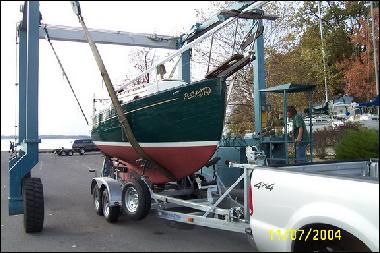
Cat's Paw (Pacific Seacraft Flicka #326) lowered onto a new Triad custom trailer. Photo: Jack Cheasty © 2006
“What does a trailer for a Flicka cost?” is one of the most frequently asked questions about this boat, and one of the hardest to answer from a web search. Custom sailboat trailers are quoted, not listed. There is no price tag on a website, because the builder has to know your boat before there is a price at all.
So here is a real one. In March 2024 I asked Triad Trailers of Raleigh, North Carolina for pricing on a new trailer for a Pacific Seacraft Flicka 20. What came back was a full Flicka-specific price schedule covering three trailer packages and every option Triad offers. This article reproduces those figures, explains what separates the packages, and covers the things that surprise people once they start doing the arithmetic — delivery, deposits, and the tow vehicle you will actually need.
About these prices. The figures below are Triad's price schedule dated 1 March 2024, quoted for a Pacific Seacraft Flicka 20. They are published here as a reference point so you can budget realistically — not as a current quote. Steel, freight and component costs have moved since. For a live number, contact Triad directly; details are at the end of this article.
Why a Flicka needs a custom trailer
A Flicka is not a trailer-sailer in the usual sense. The numbers are the whole story: roughly 6,000 lb of displacement on a 20-foot deck, an 8-foot beam, and a fixed full keel drawing 3 ft 3 in. (See the full specifications for the rest.) That combination rules out anything off a lot.
Three consequences follow. First, the weight puts you into tandem-axle territory with brakes on all four wheels — not a single-axle trailer with surge brakes on one end. Second, the full keel means the trailer has to be built around this hull: the keel support has to sit under the keel, the hull pads have to land where the hull can take the load, and the axles have to be placed relative to the boat's center of gravity so the tongue weight comes out right. A trailer that fits a fin-keel 20-footer will not fit a Flicka. Third, the fixed 3 ft 3 in draft is why the launch method — hoist or ramp — drives the price more than anything else on the list.
The 8-foot beam is the one dimension that works in your favor: at 96 inches the boat is inside the 8 ft 6 in legal road width in most states, so a Flicka on a trailer is a normal load rather than a permitted one. It does put the trailer over 80 inches wide, which is why the lighting has to meet the DOT requirements for wide trailers.
The three Triad packages
Triad builds the Flicka trailer in three configurations. The difference between them is entirely about how the boat gets on and off.
Lift-Off
The simplest and cheapest. The boat is craned or slung on and off by a travel hoist; the trailer never goes in the water. This is the right choice if your yard has a hoist and you want the trailer for winter storage, hull work, or moving the boat once or twice a year. Triad originally designed the Lift-Off for racers dry-sailing their boats, and it has become their economy option for everyone else.
Float-Off
Adds a bow stop with a 3,200-pound launching and retrieval winch (with a ladder when the design allows), carpeted keel guides to keep the boat centered coming aboard, and an axial extension tongue averaging 10 to 12 feet. The extension lets you back the trailer far enough down a ramp to float the boat off without submerging your tow vehicle's rear axle. The hydraulic brake line gets a quick-disconnect so the tongue can be extended.
One line in Triad's specification is worth reading twice: electric brakes are not recommended on float-off trailers used in salt water. If you are ramp-launching in salt, that pushes you toward the hydraulic surge models regardless of price.
Special Float-Off
Built for heavy or deep-draft boats and for owners who use a lot of different ramps — including shallow ones. Instead of a centerline extendable tongue, the extension bar is offset from the centerline and much longer; Triad's own literature quotes figures between 18 and 24 feet depending on where you look, because the length is set by your boat and your ramps. The bar is not designed to carry tongue weight — it pushes and pulls the load, and a pivot keeps it from bending — so a set of pneumatic launching wheels at the front swivel 360 degrees and take the tongue weight instead. Those wheels also let you move the trailer by hand.
The practical claim Triad makes for this package is that you should be able to submerge almost any reasonably sized boat deep enough to float it off, on almost any ramp. For a Flicka with a fixed keel and a shallow local ramp, that is the package that makes trailering genuinely workable rather than theoretical.
Flicka 20 trailer prices — Triad, March 2024
All four configurations below are tandem-axle on 5,200-pound-capacity spring-sprung axles, with brakes on all four wheels and a hot-dip galvanized frame, rated up to a 9,000-pound gross vehicle weight rating.
| Package | Brakes | Price |
|---|---|---|
| Lift-Off | 4-wheel electric drum | $7,450 |
| Lift-Off | 4-wheel GALVX hydraulic surge disc | $7,690 |
| Float-Off | 4-wheel GALVX hydraulic surge disc | $8,615 |
| Special Float-Off | 4-wheel GALVX hydraulic surge disc | $9,660 |
The headline to take from that table: the spread from the cheapest trailer to the most capable one is about $2,200, or roughly 30 percent. The step from a Lift-Off to a Float-Off — the step that turns the trailer from a storage cradle into something you can launch from — costs about $925. Buyers who expect the launch capability to be a minor upgrade are usually surprised by how modest that gap is, and buyers who assume a custom sailboat trailer starts at $4,000 are usually surprised in the other direction.
Options
The base price is a complete, road-legal trailer. These are the extras, at March 2024 pricing.
| Option | Price |
|---|---|
| Bow stop with non-marring amber roller | Included |
| Spare tire and trailer mount (ST225/75D15 LRD) | $290 |
| LED lighting package upgrade | $45 |
| Rear stabilizing jacks, 2,500 lb each (behind the axles) | $125 each |
| Ratchet tie-down straps, 10,000 lb rating, 27 ft — one pair needed | $60 per pair |
| Polymer triangular tongue toolbox (36″ × 18″ × 18″) | $270 |
| Dexter Eliminator torsion-bar suspension upgrade (includes 15″ radial tires, 5-year warranty) | $330 |
| Upgrade GALVX disc brakes to 12″ G-5 stainless steel rotors | $330 |
| Upgrade hydraulic surge to electrically activated hydraulic brakes | $970 |
| 15″ radial tire upgrade (Load Star ST225/75R15 LRD, set of 4) | $100 |
| Spare tire and mount, 15″ radial | $315 |
| 16″ tire upgrade (ST235/80R16 LRE radials) | $305 |
| Spare tire and mount, 16″ LRE radial | $360 |
Two of these deserve more attention than their price suggests. The LED lighting upgrade at $45 is the best value on the list — it carries a five-year warranty against lamp failure, and trailer lights are the single most common roadside failure on a submerged trailer. And the G-5 stainless disc brake upgrade at $330 is the one Triad specifically recommends for trailers that will be submerged or stored in a saltwater environment. If you are ramp-launching in salt water, treat that as a required item rather than an option.
Triad's own suggested packages are worth repeating. For a yacht-club, winter-storage or light-use trailer they recommend hydraulic surge brakes, the bow stop and ladder, two rear stabilizing jacks and a spare tire. For trailers that will cover serious highway mileage they add the LED package, the vented disc brake upgrade (G-5 stainless if it goes in salt), and the torsion-bar suspension.
What you are actually buying
The specification behind the price is worth knowing, because it explains the number. The frame is 5-inch structural C channel side rails with 4-inch C channel cross members, hot-dip galvanized after welding — which matters, since galvanizing a finished weldment protects the joints rather than burning the coating off them.
The axles are tandem 5,200-pound units with a 4-inch drop spindle and Dexter's Super Lube bearing system, which lets you grease the bearings through a zerk in the spindle end without pulling the hubs. Brakes are 12″ × 2″ drums on all four wheels. Tires are ST225/75D15 Load Range D on hot-dip galvanized six-hole wheels, 10,160 pounds of combined capacity. The surge actuator is a Dexter Model 165 rated at 16,500 pounds and wants a 2-5/16″ ball rated to at least 9,000 pounds. Two safety cables, 12,000 pounds each.
The part that matters most for a Flicka is the hull support. Six adjustable screw poppet pads carry the hull, with two rollers forward of the keel under the centerline, and the keel itself sits on 9- or 10-inch structural C channel covered in marine-grade carpet. Because the pads adjust in height, you can drop one at a time and work on that patch of hull with the boat still on the trailer — Triad claims full hull access on 98 percent of the trailers they build. For an owner who plans to do their own bottom work in the driveway, that single feature may justify the trailer on its own.
The costs that are not on the price list
Three things routinely catch buyers out.
Delivery. Triad is in Raleigh. Unless you are collecting the trailer yourself, it ships through a drive-away carrier — Triad names Quality Drive Away and Baker Transportation — at roughly $1.40 to $2.00 per mile, shared out when trailers are grouped together. You pay the carrier directly, not Triad, because North Carolina law prevents them from adding delivery to the invoice. Budget an unloading fee under $100 on top. From Raleigh to the Great Lakes or the Gulf that is a few hundred dollars; to the West Coast it is a serious line item, and worth pricing before you compare builders.
The deposit and the timeline. Triad asks 50 percent down before construction starts, by check — they do not take credit cards. Build time runs four to six weeks depending on the season, and they suggest ordering in the fall for early-spring delivery, when their shop is quieter.
The tow vehicle. This is the one that undoes budgets. The trailer is rated to 9,000 pounds gross, and a Flicka at 6,000 pounds displacement plus mast, ground tackle, fuel, water and the trailer's own steel puts you realistically in the 8,000-pound-and-up range going down the road. Do not plan around the boat's 6,000-pound displacement figure. That is three-quarter-ton truck territory for anything beyond an occasional short haul, and you will need a 2-5/16″ ball rated to 9,000 pounds and — on the electric-brake models — a brake controller in the cab. Triad will not advise you on tow vehicles and says so plainly; that question goes to your vehicle manufacturer's tow ratings.
Finally, the trailer registers like a vehicle: you take the certificate of origin and the invoice to your DMV.
Other options for a Flicka trailer
Triad is not the only road to a Flicka trailer, but the field has narrowed. Trail-Rite of Santa Ana, California built Flicka trailers for years and was the closest builder to the old Pacific Seacraft factory; their shop is now listed as closed and their website has not been updated since 2000. Anyone repeating that recommendation is working from old information — including, until recently, this site.
That leaves three practical routes: a new custom trailer from Triad or another custom sailboat trailer builder; a used Flicka trailer, which surfaces occasionally when a boat is sold without one; or a used trailer from another boat re-fitted with correct pads and keel support. The third is cheaper and is where most of the horror stories come from — a keel bearing on the wrong spot or hull pads carrying load the laminate was never meant to take will cost more than the trailer saved. If you go that route, have the support geometry worked out properly.
It is also worth knowing that Triad keeps trailer plans for hundreds of sailboats going back decades, and the Flicka is an established one in their files — they have a Flicka page in their own gallery. You are not asking them to design from scratch.
Getting a quote
Pricing changes, and the figures above are a snapshot from March 2024. For a current number:
Triad Trailers LLC
5831 Triangle Drive
Raleigh, NC 27617
Phone: 919.782.6007
Email: Mike@TriadTrailers.com
www.triadtrailers.com
The full brochure Triad sent, with all four price tiers, the complete options list and their materials specification, is reproduced here: Triad Trailers Flicka 20 price schedule and specification, 1 March 2024 (PDF).
Before you order. Two other articles on this site cover what happens after the trailer arrives: lowering a Flicka mast with a gin pole, which one person can do at the ramp, and launching a Flicka from a trailer when the ramp will not take the wheels deep enough. Read the launching article before you choose between the Float-Off and Special Float-Off packages — your local ramp will make that decision for you.
Owner photographs of Flickas on Triad trailers, including Ben Main, Jr. (hull #315) and Cat's Paw (hull #326), are in the older Flicka Trailers article.
More on trailering a Flicka 20
- Flicka Trailers — Tom Davison's 2006 survey of trailer types, with owner photographs.
- Trailer Sailing a Flicka — launching, retrieving and rigging on the ramp.
- Flicka Friends, Fall 2003 — the trailering issue — seven owner accounts, each now on its own page: trailer recommendations, towing advice, getting the mast down, tuning a new trailer to the hull and building a cradle.
- Launching a Flicka and Lowering the Mast.
Advertisement