Flicka Friends · Fall 2000 · Vol 5, #3
Installing Radar on s/v HOTSPUR, # 386
By Eric Jungemann · page 8 of the Fall 2000 issue
I sail s/v HOTSPUR (Flicka #386, formerly “SENIOR FROG”) on San Francisco Bay. I have done a fair amount of short-handed sailing (Single-handed Transpac, Double-handed and Crewed Pacific Cups) and wanted a strong, small cruising boat with trailering capability, low draft for rivers, canals and shallow anchorages, and an ocean pedigree. I had always admired the Flicka and found mine through California Cruising Yachts in Alameda (who did an excellent job as the broker and act as a hub for Pacific Seacraft sailors in our area). My previous racing boat had a radar that I took with me when I sold it and I decided to mount the radar on the Flicka. I know that a number of Flicka’s have radar but I had not seen a specific article so I decided to recap my installation as a possible solution for other skippers. Bob Sansone, a great sailor, medical doctor and boatwright (what a combination!) helped enormously on the planning and installation. As you can see in the photos, the Furuno 1621 Mark II Radar is mounted on an Edson Standard Radar Mast with an Edson Basic Radar Platform and an Edson cockpit flood light. The low-end radars in general have small radomes, small LCD displays and low power consumption and are also the least expensive! The radar mast is mounted on an Edson Pivoting Mast Mount so it can be stored for trailering or for low bridges with about three minute’s effort. The decision for a mast mounted, backstay mounted or tower mounted radar is a series of tradeoffs. I like the idea of a tower mount, particularly on canals or rivers, so that the radar can be used independently of the mast being up. Also, the windage aloft is reduced and the installation is a little easier. But I can also understand the approach for a mastmounted radar including lower overall weight and greater radome transmission visibility.
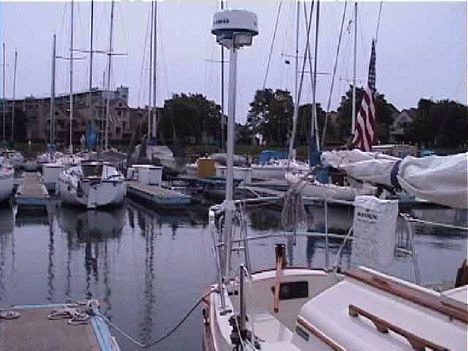
The radar was installed on an Edson post located on the starboard side of the cockpit and is supported by the aft pulpit.
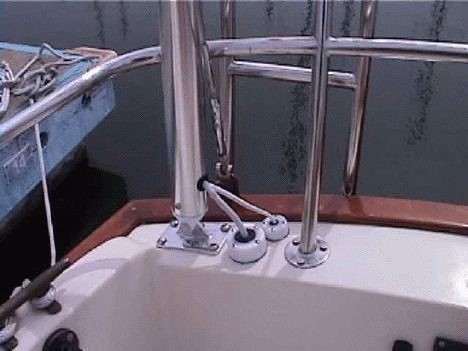
The picture shows the base of the Radome support post and the watertight electrical connections. The wires run forward to the display located just inside the cockpit.
Advertisement
s/v HOTSPUR, # 386 One aspect of a tower mount is the decision of what height to mount the radar. Each radar will have an angle of transmission that must be taken into consideration. Ideally, the higher the mast, the better the installation but there are real world tradeoffs. Since the Flicka is initially tender, a taller mast increases the weight aloft in terms of absolute weight and position. Also, a taller mast needs greater support. I have the mast relatively low but at a height that still keeps the heads of crew out of the radiation near the radome. Equally, we feel that while the radar is on, the crew will be in the cockpit or below, probably seated or the radar will be off or in standby mode. These are all tradeoffs that each owner needs to take into consideration.
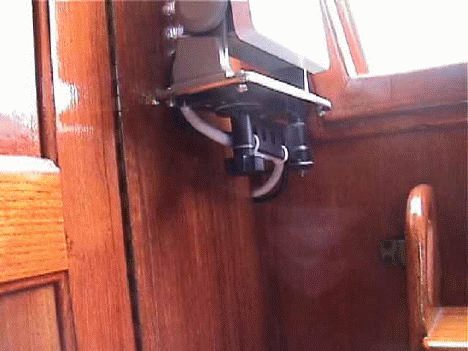
The picture shows the swivel mount for the LCD display. The pivot arm is mounted very close to the companionway bulkhead with just enough room to adjust the arm.
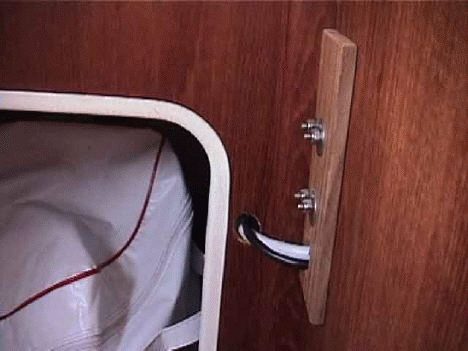
The picture shows the backing plate for the LCD mount. The cable routing into the locker just behind the head. The excess cable is coiled there next to the holding tank hoses.
We mounted the radar on the starboard side because of ease of cable routing and battery connection. The radar tower is near the stern ladder but doesn’t really interfere with the ladder’s infrequent use. The tower is outboard and aft of the split backstay so it doesn’t interfere with the mainsheet or tiller. We mounted the mast pivot abeam vs. fore and aft. We preferred a fore and aft orientation but the possible locations and hull curvature made this installation preferable. Edson provides a backing plate for the pivot fitting. You will probably need a deep socket to tighten the nuts as well as a socket extension. To drop the radar mast, disconnect the pulpit supports (necessary in any case) and pull the pivot pin and lay the mast down. Be sure to allow enough slack in the cable before the deck connectors. CableClam connectors were used as through-deck fittings (Blue Sea Systems and available from West Marine). There are two connectors: one for the radar and one for the deck floodlight. It is possible to use one connector but it won’t be as water-proof. Leave a little slack underneath the deck as well as enough slack above deck to lay the mast down. The deck floodlight has a separate watertight switch.
Transcribed from Flicka Friends, Fall 2000 (page 8). Read it as originally printed in the PDF, or see everything else in this issue.
Boats in this story
Each links to the boat's page in the Flicka 20 registry.
Advertisement
Keep reading — next issue
Flicka Performance Under Sail Rod Bruckdorfer · Spring2001More from the archive
Every surviving issue is in the Flicka Friends archive. Looking for a particular boat? Try the Flicka 20 registry.